













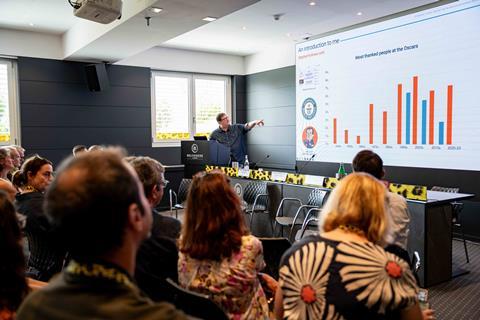
Most of this century’s top grossing films were made by ‘nepo baby creatives’, according to research presented at the Locarno Film Festival’s StepIn industry conference.
Some 70% of the top 100 grossing films made between 2000 and 2025, some 2,600 in total, had a “nepo baby creative”, according to film industry analyst Stephen Follows.
A film was categorised as such if its director, writer or any of its top three actors had a family member already working in the film industry. The family member could include a parent, grandparent, uncle, aunt, cousin or sibling.
People with family ties to the industry on average make their first film at 33, compared to 35 for those without. They are also more likely to make a second film.
“It really helps to have somebody you already know in your family who’s in the industry,” said Follows. “Family ties get you in younger. And they help you get up the ladder quicker. They buy persistence. You’re more likely to stick around in the industry. You’re more likely to make more films.”
Follows noted that such creatives might not have benefitted from nepotism in the purest sense by being given jobs simply for who they are related to. “It might be they grew up around the industry, they understand things, or people recognise them. I’m not saying they have no merit and they’ve just been pushed in, but it’s massively helped.”
Follows did not provide examples of films, but family dynasties such as the Fondas and Coppolas have long been prominent in Hollywood.
Elsewhere, Follows said research showed that just 3.4% of US independent films make a profit. The figures spanned 1999 to 2018. He noted that one-in-10 independent films over the period made it to theatres; of those that did, about one third made a profit. By comparison, he estimated that 51% of Hollywood studio films made a profit.
His advice for investors looking to make money in the film industry was fourfold: spread your bets across many films; spend other people’s money; control a valuable asset, such as a script, and charge for it; and sell services, tools, finance, or the illusion of control.
Industry privilege
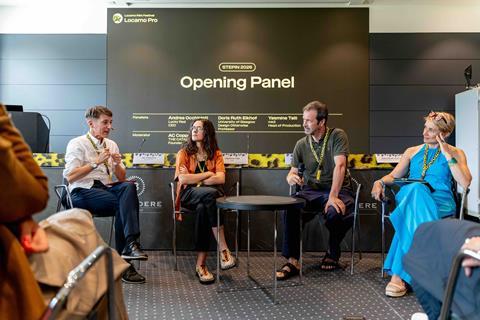
The challenges facing filmmakers were underlined in a subsequent StepIn panel session featuring Andrea Occhipinti, CEO of Italian distributor and producer Lucky Red; Doris Ruth Eikhof, professor of cultural economy & policy at the University of Glasgow; and Yasmine Talli, head of production at French producer, sales agent and distributor mk2.
Eikhof said statistics about diversity in film have not changed dramatically in the past 20 years. “You don’t have to be a white, cisgendered, non-disabled man to work in the film industry, but it helps,” she said. “Privilege is something which is very present in the industry.”
Eikhof said audiences are seeing more people from minority ethnic groups on screen, as well as more disabled people and over 50s in less stereotypical roles. But the statistics on who works behind the camera and, crucially, who finances films are not yet readily available.
Eikhof cited research she had undertaken with fellow academic Amanda Cole on how women are considered a risk in film production, noting that backing women filmmakers is widely regarded as riskier than supporting male filmmakers.
She quoted research that showed that although women have less access to funding, they use it more efficiently when they receive the money. “Films produced by men need €41 to sell one ticket. For women, it is €13. Men directors spend almost four times the amount of budget per cinema ticket than women - €32 compared to €7,” said Eikhof.
Although films made by women are less likely to play at festivals, Eikhof said those that are selected have longer and more successful festival runs. She said that individual films by female filmmakers will play at an average 3.3 festivals while those by men will play at 2.7.
The challenges of the industry were also underlined by Talli, who noted that mk2’s sales team will receive more than 400 projects a year, but will work on only about 15 to 20. She said the company had to be highly selective, and focused on “very original” projects that would stand out in the market.






No comments yet