



Film follows the acclaimed writer and his wife as they heal from the 2022 knife attack on Rushdie
Dir: Alex Gibney. US. 2026. 107mins
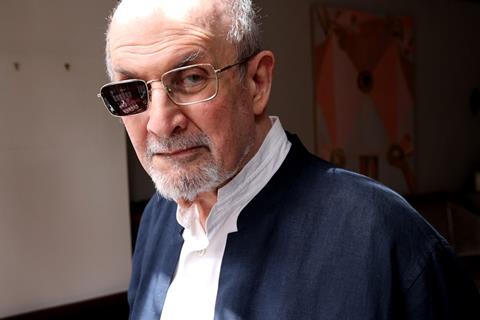
“When death comes very close to you, the rest of the world goes far away and you can feel a great loneliness,” writes author Salman Rushdie in his memoir Knife: Meditations After an Attempted Murder. As Alex Gibney’s intimate and moving documentary shows, The Satanic Verses writer was also the recipient of great love from his wife, fellow writer, photographer and visual artist Rachel Eliza Griffiths, who was with him every step of the way after he was nearly killed in a knife attack on August 12, 2022.
A testament to Rushdie’s humour and resilience
Passages of his memoir, along with some of his other writing and footage shot by Griffiths on Rushdie’s gradual road to recovery, form the backbone of Alex Gibney’s intimate and moving documentary – a detailed film that contextualises the attack while also offering a profile of Rushdie’s life and philosophy, and a testament to his humour and resilience. Compelling and immersive from the start, further festival play and wide distribution after its premiere as a Sundance Premiere seems assured, given the established reputation of both Gibney and his subject.
Beginning with re-enactment of the attack – shocking actual footage is shown later – the film then details the aftermath as Rushdie lies frail in a hospital bed after being stabbed 15 times as he prepared to give a talk in Chautauqua, New York State, about keeping writers safe from harm. His injuries are horrendous, but he and Griffiths become determined to document his recovery in a Pennsylvania hospital. Griffiths also articulates her own thoughts and fears in video diaries.
Gibney, helped by strong editing from his long-time collaborator Andy Grieve, skilfully weaves together this verite footage with a wealth of archive material, film clips from everything from The Seventh Seal to The Diving Bell and The Butterfly, and monochrome animation that helps to illustrate Rushdie’s more philosophical ruminations on life, death and the intimate nature of a knife attack. The film also takes time to clue us into Rushdie’s childhood in India, his violent father and his British education, giving enough detail to anchor the writer and his work without becoming a distraction from the focus of the documentary.
Archive footage emphasises just how serious things got for then London-based Rushdie in the wake of the publication of The Satanic Verses in 1988, when Iran’s supreme leader the Ayatollah Khomeini, outraged by what he viewed as a blasphemous depiction of the Prophet Muhammad, issued a fatwa calling for the author’s death. International newsreels show people openly expressing the desire to make the fatwa a reality, including Yusuf Islam (Cat Stevens). The use of Islam’s song ‘Moonshadow’ in the documentary is perhaps a surprise given the singer’s endorsement of Khomeini’s position at the time. Violence wasn’t far behind, with bookshops firebombed and a Japanese translator of the book murdered. (An Italian translator was also targeted but survived.)
Rushdie refused to be cowed by any of this, continuing to advocate for free speech even as he was moved about under police protection like a hostage. But as the years passed, the author began to relax, moving to New York, first under the radar but then reclaiming much of his profile. Considering the assassination attempt itself, Rushdie refers to his would-be killer Hadi Matar – who is currently serving 25 years for attempted murder – as “the A”. Matar, who wasn’t even born when The Satanic Verses came out but was radicalised online, is rightly kept on the fringes of this film, but we are privy to imagined conversations Rushdie had with him about the attack that form part of his memoir.
“I want to be a confident person again,” says Rushdie as he takes his journey full circle by returning to the stage where he was stabbed. It’s questionable, however, whether Gibney needs to show the murder attempt in slow motion and more than once – a decision that would be more suited to a true crime documentary than this much more contemplative affair. It does, however, also serve to emphasise the positive side of humanity, as many audience members rushed to help, risking their own lives in the process.
Throughout the film, three things stand out: the love between Rushdie and Griffiths; the resilience they had in the face of his catastrophic injuries; and the author’s humanistic attitude and sly sense of humour, which have categorically survived intact.
Production companies: Jigsaw Production
International sales: Anonymous Content, NShumaker@anonymouscontent.com / UTA, BrunnerA@unitedtalent.com
Producers: Alex Gibney, Erin Edeiken, Sruthi Pinnamaneni
Cinematography: Rachel Eliza Griffiths
Editing: Andy Grieve
Music: Will Bates