








The film premieres in Toronto before heading to London
Dir: Susanna White. UK. 2026. 109mins
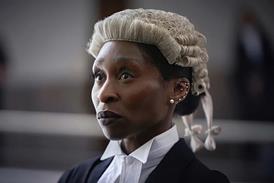
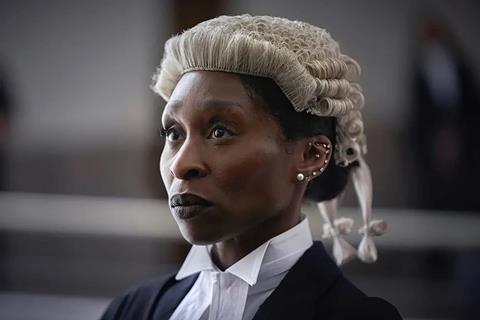
The social justice courtroom drama from director Susanna White is an underwhelmingly flat message picture, whose efforts to raise awareness about sexual assault against women is stymied by on-the-nose creative choices and writerly missteps. Suzie Miller adapts from her own acclaimed one-woman play, and the narrative follows Tessa (Cynthia Erivo), a steely-eyed barrister who accuses her boyfriend/fellow barrister Julian (Daniel Ings) of raping her. With a speciality in defending men on trial for sexual assault., Tessa knows how much the courts systematically favor men. But she’s determined to prove her case, even if it means losing everything she’s worked toward.
Retools previously concise material but doesn’t discover any greater thematic complexities
After its premiere as a Toronto Gala Presentation, the film heads to BFI London Film Festival. Despite its wobbly quality, Wicked star Erivo brings enough star power to court buyers, especially those interested in a female-centered project whose heartfelt politics are urgent and galvanizing.
Tessa is at the top of her game. At the Old Bailey she confidently jousts in charged trials. In the film’s opening scene she takes us, via her internal monologue, step-by-step through her thought process as she dismantles a lying witness. She knows just how much to push the witness to have them hang themselves without angering the jury. That quality is necessary considering she routinely defends accused rapists. At a later moment, Tessa’s interior monologue – which often sounds like a competitive play-by-play analyst – guides us as she attempts to poke holes in a female accuser’s story. It’s a slimy job, but in Tessa’s mind, somebody’s gotta do it.
Tessa can’t afford to say no to these cases. Though she’s nominated for the junior barrister award and is admired by her peers, she knows her working class background —her father abandoned when she was young, her mother (Noma Dumezweni) works as a cleaner, her brother (Toheeb Jimoh) is employed on building sites — automatically puts her at a disadvantage against her white trust fund colleagues. And while she attended Cambridge, she did so on a scholarship. Once you add the racial component, on which this film remains frustratingly light touch, then you can understand why Tessa is persistently afraid that she’ll lose her place at the table.
That’s why it’s a big leap for her to date Julian. A barrister riding a quick ascension, Julian does come from money so he’s never had to question his place, importance, or future. He’s also tall, charming, and handsome. As one colleague says to Tessa, “He’s the complete package.” Tessa agrees. The pair begin a passionate consensual relationship that inspires Tessa to leave her hardened cocoon. Her security crumbles when one night, Julian rapes her in a harrowing scene that’s shot by DoP Mike Eley (Elsinore) to emphasize her physical response to the attack, rather than her emotional trauma.
Writing the screenplay, White retools her previously concise material but doesn’t discover any greater thematic complexities. As you would expect, Tessa provides the details of her visit to the Miller station to report the crime, which includes her complaining to herself about her deleting text messages and taking a shower after the assault. Yet neither of these components loom large; White’s script simply drops them from the narrative. Instead, we speed to over 1000 days later, and the first day of the trial. There, on the witness stand, Tessa looks wistfully at her family.
In the cross-examination scenes, Eley relies on close-ups that knowingly suggests unease and intrusiveness. We’re also in Tessa’s head as she navigates what she thinks Julian’s high-priced family friend/lawyer might pull on her. Literalizing Tessa’s thoughts often undercuts Erivo’s passionate performance, because she’s not allowed to land the character’s emotions without the overactive editing and heavy duty monologue handholding the audience.
That guidance should have instead been dedicated to explain why a Black female barrister known for using the law to stab holes into rape cases, would remotely believe the system would work for her. One would have to make the leap that Tessa has tried so hard to assimilate that she’s become blinded to reality: the courts aren’t some divine arbiter of truth. They’re flawed. But her logic is a leap we must make rather than the film earning it. In that regard, Prima Facie struggles to feel truthful, or engaging.
Production companies: Bunya Productions, Embankment Films, Edith’s Daughter, Minderoo Pictures, Camelback Productions
International sales: Embankment Films info@embankmentfilms.com
Producers: Greer Simpkin, Kevin Loader, David Jowsey
Screenplay: Suzie Miller
Cinematography: Mike Eley
Production design: Patrick Rolfe
Editing: Justine Wright
Music: Isobel Waller-Bridge
Main cast: Cynthia Erivo, Daniel Ings, Noma Dumezweni, Toheeb Jimoh, Elizabeth Dulau, Harry Treadaway, Khalid Abdalla, Elliot Levey, Simon Russell-Beale, Sarah Junillon