




David Shadrack Smith’s Sundance title uses archive footage to recall the glory days of public access television
Dir: David Shadrack Smith. US. 2025. 107mins
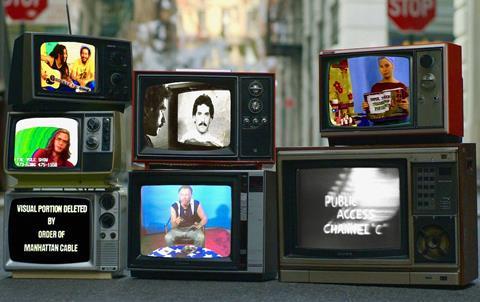
Before social media, or even the internet, there was public access television. Created in the US in the late 1960s and taking cultural hold in the 1970s and 80s, this form of non-commercial mass media allowed ordinary people to create content free of editorial censorship, which was broadcast on dedicated cable TV channels. This warm-hearted, energetic, if slightly unwieldy archive-driven documentary goes behind the scenes of the early years of New York’s Manhattan Cable to explore the tenets of community activism and free speech on which the initiative was founded, and the early breed of influencers who both amplified and corrupted its message.
Warm-hearted and energetic if slightly unwieldy
Premiering in Sundance’s US Documentary Competition, Public Access is most likely to appeal to US audiences who remember the glory days of the medium. The presence of Steve Buscemi and Benny Safdie as executive producers could help raise its profile, although it’s likely a better fit for streaming and broadcast platforms.
Debut feature director David Shadrack Smith has chosen to tell this story using well-chosen archive footage of public access content, overlaid with present-day audio interviews with its major players. While Time Warner owned Manhattan Cable, the city franchise included (and still does) a protected mandate for free-to-use public access channels, and staffers recall their excitement about how new technologies – portable video cameras, cable TV – were opening the door to grassroots community engagement. It wasn’t really regarded as entertainment so much as political activism, a way of empowering individuals outside of the reach of mainstream media. “The content was completely irrelevant,” recalls scheduler Emily Armstrong.
Clips of the shows amplify the eclectic, eccentric programming that viewers could expect on a daily basis. The surly Steve Gruberg was an early star, his ‘Grube Tube’ show encouraging New Yorkers to call in and talk about anything they wanted. ‘Glenn O’Briens TV Party’ featured an eclectic range of musicians, with Debbie Harry as a regular guest. Bob Gruen, a photographer who recorded shows at legendary New York music venue CBGB, was thrilled he had a way to get his footage to a wider audience – although viewers were perhaps more than a little shocked when he broadcast candid video of his wife giving birth.
Indeed, the film highlights that tensions around the freedom to make such transgressive, boundary-pushing content and the need to safeguard audiences were present from the beginning. Video artist Anton Perich’s explicit content could certainly be seen to be offensive, while Manhattan Cable staffers lament the fact that a creator named Ugly George was able to beam his misogynistic stream of consciousness into homes entirely unchecked. Pornographic show ’Midnight Blue’ proved hugely popular – and hugely problematic for Time Warner. In 2000, ’Midnight Blue’ creator Al Goldstein won a years-long legal battle against Time Warner’s plans to scramble sexually explicit public access programmes unless subscribers gave written consent.
Even as the public access waters muddied, gems continued to surface. Gay show ’The Emerald City’ emerged just after Stonewall, at a time when the LGBTQ+ lifestyle was not represented in the mainstream. During the 1980s, shows like this and the more explicit ’Men & Films’ became trusted information sources in helping men navigate the AIDS epidemic. Feminist show ’Paper Tiger Television’, created by DeeDee Halleck, offered teenage girls a worldview away from the glossy conformism of magazines like Seventeen. And Earl Chin’s ’Rockers TV’ gave vibrant voice to New York’s Jamaican community.
As fascinating as all this footage is, the rough-around-the-edges reels can start to feel rather repetitive – it may have had more of an impact if it had been broken up by talking heads – and there’s an unsurprising focus on the more extreme end of the scale. And it would certainly have been interesting to see where some of these creators ended up. (A handful are interviewed, including Chin, but only about their experiences at the time.) Still, the film remains a fascinating snapshot of a particular cultural moment and a timely study of our enduring need to connect.
Production companies: Olive Productions, part2pictures
International sales: WME, MAGS@wmeagency.com
Producers: Sara Crow, Anne-Marcelle Ngabirano
Editing: Geoff Greutzmacher
Music: adore