















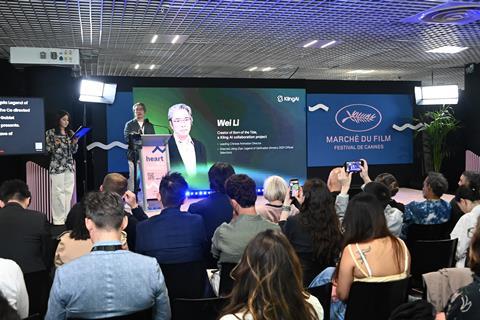

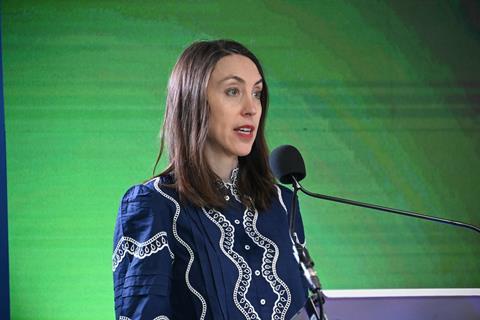
Leading filmmakers sought to lay to rest several misconceptions about AI during a Cannes Marché du Film panel titled “From Creative Possibility to Production Reality: Kling AI in Cinematic Workflows”. The main one is that AI is somehow a “magic button” for making movies.
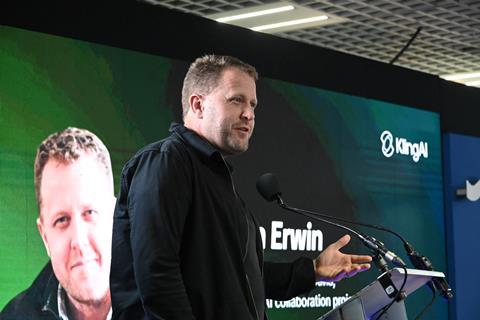
“The most common misconception is that these tools somehow create for you. They do not,” US director Jon Erwin, founder and CEO of Innovative Dreams, told a packed audience at the Kling AI event, held in association with Winston Baker and Mimaoku and moderated by Screen’s French correspondent Rebecca Leffler. Erwin is series creator of Amazon Prime Video’s House Of David and companion series The Old Stories: Moses, which used generative artificial intelligence platform KlingAI’s tools.
The tools, he said, “accelerate and amplify your creativity. He predicted “an explosion of creativity and originality” once products like Kling AI 3.0, its latest AI video engine, are more widely available.
Others also forecast that AI will pave the way for greater “diversity and variety” in filmmaking.
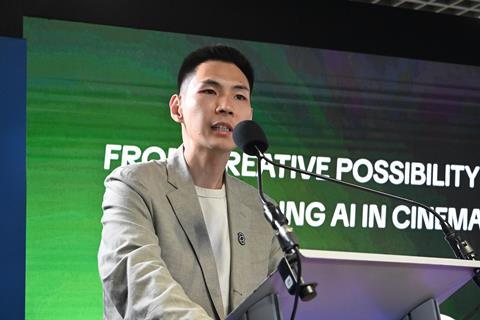
Leading Chinese animation director Wei Li is creator of Born Of The Tide, on which he is collaborating with Kling AI. He spoke of the opportunities AI is giving not only him but his crew members. “You can use the AI to free your hands, express your mind and utilise your imagination more,” he said.
Wei Li recalls that when he started working in the industry, animation was a painstaking, labour-intensive craft. “I was very happy and passionate when I was doing the drawings for days and days,” he recalled. He used to have a student who helped him scan storyboards into digital files. This student stayed up “for the entire day and night. I felt very sorry for him. I was enjoying the session but he was just doing the repetitive work. Standing beside him, I felt I was watching a robot.”
The veteran Chinese animator reminisced about a working environment a decade ago in the era of CG effects when big-scale animation like his project Jiang Ziya: Legend of Deification “involved a team of thousands of people” and took four to five years to complete.
“To be honest, I was so depressed for three to four years after finishing that film,” he remembered. “If there was one thing the director hadn’t thought through, he was using other people’s lives to accompany his trial and error…this way has been too stressful for me.”
Now, that drudgery has been removed. Animation teams are far smaller - and far more creatively involved.
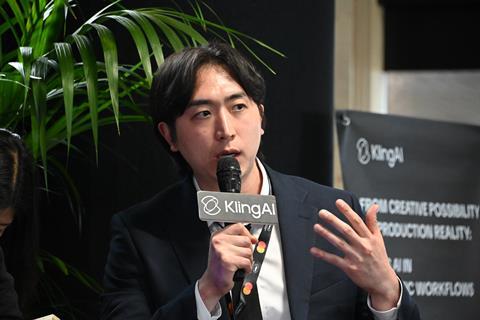
“[But] the biggest misconception is that we are using AI just because we want to make films cheaper and faster,” said South Korean director Eekjun Yang. His new sci-fi action feature Raphael is generated entirely by AI, and made through Mateo AI Studio & MBC C&I AI Content Lab.
Its director acknowledged he would have struggled to make it at all without the AI. “For a director like myself who is not famous yet or has never had experience making feature films, it was very hard to obtain any investment in the first place. Therefore, AI tool use was not a choice but a necessity.”
“The fact that it [AI] is cheaper and faster is a by-product of the fact that it is more creative, more intuitive and a more collaborative way to work,” Erwin agreed. “What I love about this technology is that, over the course of time, for filmmakers in any form, the barriers are going to go away and you’re just going to tell your story to your audience. It really is going to usher in a moment in our industry that I think is going to create a lot of jobs - the only limit is the storyteller’s imagination, the quality of their story and how good they are telling it to those around them.”
One paradox is that smaller, more intimate scenes (“the detailed emotional expressions of the characters” as Yang called them) are often more challenging to render through AI tools than complex action scenes. But Yang claimed that “Kling is exceptional in its emotional expression.”
Kling AI may be only two years old but, as the company’s Tony Pu, head of creator community and partnerships, quipped, “two years in AI is like six years in real life.”
The company, Pu said, has “already served more than 60 million global creators…it has really been quite a journey.”
As the event ended, Pu announced that Kling is to partner with UK company Evolutionary Films on new family animated project, Minibots, about tiny robots. This is scripted by Michael Ferris and features character design by Tony Bancroft. Kling is now aboard as exclusive technological brand partner on the project.





No comments yet