










Zou Jing’s Critics’ Week premiere features an impressive performance from Resurrection star Li Gengxi
Dir/scr: Zou Jing. China/France. 2026. 125mins
Introduced in 1979, China’s controversial one-child policy prompted a rapid increase in adoption, with millions of adopted children living within the country by the late 1980s. The link between an entrenched cultural preference for sons and the over-representation of girls in adoption figures was previously detailed by Wang Nanfu’s harrowing documentary One Child Nation (2019), and now the trauma of abandonment is dramatised in Zou Jing’s feature debut A Girl Unknown. Unfolding over one formative decade, this emotionally draining yet ultimately hopeful coming-of-age story finds its titular protagonist not only living in four environments, but taking on three names. In a commendably restrained manner, Zou closely examines how such cycles of displacement cause existential anxieties to fester to the point of identity dissolution.
A largely subtle exploration of a young life characterised by uncertainty
Receiving its world premiere in Cannes Critics’ Week (where it won the Next Step Hildegard award in 2024), A Girl Unknown should make an impactful impression on festival audiences due to its sensitive handling of subject matter that has only occasionally been addressed in productions bearing the official stamp of approval from China’s state film authorities; notably Wang Xiaoshuai’s decades-spanning So Long, My Son (2019). It is also likely poised to command significant attention from international art-house distributors, as Zou confidently synthesises the verisimilitude of China’s socially conscious Sixth Generation with her fiercely personal interrogation of recent Chinese history.
In the early 1980s, six-year-old tomboy Wang Juan (Cao Ruofan) is experiencing a relatively idyllic rural childhood. When not attending school, she enjoys swimming and flying kites, and can also hold her own in occasional physical altercations with the village bullies. But when her mother Ah Hui (Luna Kwok) falls pregnant, Juan is uprooted to the city with the attentive Ding Meishuang (Shen Jiani) and her indifferent husband Wang Weiqiang (Zu Feng), who become her legal guardians.
This awkward adjustment is helped by the fact that Meishuang enrols Juan in dance classes. Yet this unresolved rupture is exacerbated when Juan discovers Meishuang’s reason for adopting. As a teenager (now played by Li Gengxi), Juan withdraws socially after being sexually assaulted and undergoes two further relocations: firstly, to the home of another family, then to the dormitory of a garment factory where she is employed as a low-wage machinist. There are periods of companionship, but self-love is perpetually out of reach.
A Girl Unknown finds Zou further developing the sensibility of her deliberately paced short Lili Alone (2021) which concerns a young woman from a rural area who temporarily relocates to the city when a surrogacy scheme offers a quick fix for her family’s financial problems. Style and tempo here are similarly naturalistic and keenly observational. Predominantly height-level cinematography by Liang Zhongqiang intimately captures Juan’s childhood perspective in the first half, while careful editing by Zou and Tina Baz conveys a sense of time passing. Changes in youth fashion, energetic bursts of Juan’s pop music tastes and the iconic Trainspotting (1996) poster on her bedroom wall provide immersion in a domestic space and urban community that only affords the protagonist a limited sense of belonging.
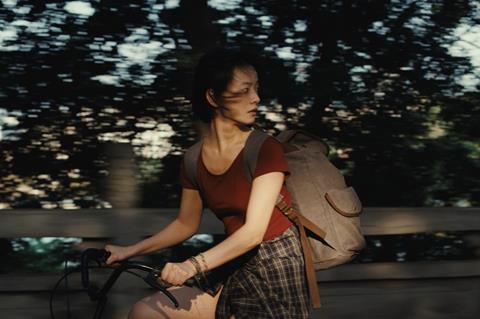
At the film’s core are impressive performances from child actor Cao and versatile rising star Li Gengxi, whose credits range from the gritty television series The Long Season (2025) to Bi Gan’s fantastical reverie Resurrection (2025). Cao possesses an unaffected quality, oscillating between precocious pluckiness and moments of disorientation which provide a foundation for Li’s adolescent turmoil. Li has only been on screen for a few minutes when the teenage Juan lets rip with a silent scream, but the pent-up frustration is seamlessly carried over.
Although the consequences of the one-child policy reverberate throughout, Zou’s humanistic screenplay enables her supporting cast to illustrate other forms of profound pain. Shen and Zu’s nuanced interplay gradually crystallise into a quietly powerful portrayal of marital strife, while the private shame of Juan’s factory co-worker Fang Fang (Wang Yidi) adds to the film’s stinging critique of patriarchal societal structures.
There are a few false notes in the final stretch when Zou’s largely subtle exploration of a young life characterised by uncertainty is slightly undermined by didactic dialogue regarding the nature of existence. Furthermore, relying on the traditional symbolism of water as rebirth registers as cliché within the otherwise realist aesthetic. Nevertheless, these minor stumbles are largely eclipsed by Zou’s remarkable ability to viscerally distil various repercussions of a far-reaching social engineering project into a single, credibly lived experience.
Production companies: Pure Light Films, Maneki Films, Memoria Films, Emei Film Group, Eagle Media
International sales: Pyramides, sales@pyramidefilms.com
Producers: Wang Yang, Cao Xi, Didar Domehri
Cinematography: Liang Zhongqiang
Production design: Xing Jun
Editing: Zou Jing, Tina Baz
Music: Valentin Hadjadj
Cast: Li Gengxi, Shen Jiani, Zu Feng, Cao Ruofan, Luna Kwok, Wang Yidi