













Screen International is profiling all the winners of the fourth Global Production Awards, which were held tonight (May 18) at the Mademoiselle Gray Barriere in Cannes.
Outstanding Use Of Locations
Winner: Rental Family Knockonwood & Searchlight Pictures
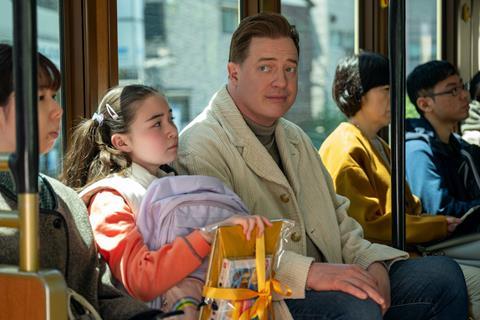
The use of locations in Hikari’s Rental Family did more than just establish a sense of place. It gave the story a deep and purposeful visual language. The Searchlight Pictures production, starring Brendan Fraser, follows a down-on-his-luck US actor in Tokyo, whose life is changed when he joins a ‘rental family’ firm and is hired to play a father to a young girl.
Filming took place in Japan over 48 days in spring 2024 and was based primarily in Tokyo, at locations such as the teamLab Borderless digital art museum and Tokyo Hat Club, which provided the setting for the rental family offices. Further filming took place in neighbouring Kanagawa, Yamanashi, Saitama, Chiba and Ibaraki, while broader locations extended to the natural landscapes of Shimabara in Nagasaki and Amakusa in Kumamoto.
“Rental Family features an unusually high number of locations compared to a typical drama,” says producer Shin Yamaguchi of production company Knockonwood. “Depicting the many different forms that a family can take required a rich variety of settings. Our location selection was a blend of two approaches — some locations were found based on the script, while others inspired the script itself.”
Sense of place
Locations for the final scenes between Phillip (Fraser) and a retired Japanese actor were inspired during the screenwriting phase by the location team. “Hikari travelled to those regions, and what she experienced there was woven directly into the script,” recalls Yamaguchi.
Choosing to set these moments in the picturesque locations of Amakusa and Shimabara was deliberate. “Where Tokyo compresses identity, these landscapes allow it to unfold,” he says. Every location choice was driven by a clear directive: “Selecting locations based solely on beauty or novelty would not suffice.”
Avoiding this pitfall was made easier by having a Japanese director on a US studio film. “When international directors come to Japan to scout locations, it is rare for them to consider deeply what a place signifies, the history behind it and how a Japanese viewer would perceive it,” says Yamaguchi. “Hikari understood all of that intuitively. On top of it, she was also thinking about how to present these locations through the lens of an international film, a Hollywood production. The bar was extraordinarily high.”
That bar was met, if not exceeded. “Rental Family breaks away from the postcard image of Tokyo, revealing a city that feels both intimate and estranged at once,” wrote Screen International critic Robert Daniels.
This was the team’s intention, says Yamaguchi. They sought to “position Tokyo not as a spectacle, but as a lived, psychological environment”.
However, authenticity and good intentions do not a production make. The challenges are many for Rental Family or any large-scale production shooting in Japan. Permits take time, and securing locations requires negotiating with various public bodies as well as private residents.
“There have been cases where filming was suspended due to accidents, noise complaints or concerns about environmental impact,” says Yamaguchi.
The producer identifies the biggest culture gap as the Japanese penchant for equivocation. “Ideally, when you say, ‘We would like to film at this location,’ the response would simply be, ‘Understood — let’s secure the permit.’ But for locations perceived as difficult, there is a tendency to hedge more than might seem necessary. This comes from a genuine desire not to disappoint, should the permit ultimately not come through.”
However, he also says that his experience on Rental Family proved that “once you understand this cultural backdrop, things have a way of resolving themselves”.
“The Japanese sense of responsibility is exceptionally strong,” adds Yamaguchi. “Careless handling that leads to poor outcomes is rare. On the contrary, the Japanese instinct is to spare no effort in steering things toward the best possible result.”
On Rental Family it took “persistence, precision and creative problem-solving”, he says. “And in doing so, the film found its truth.”




No comments yet