



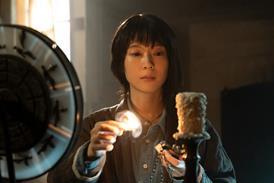
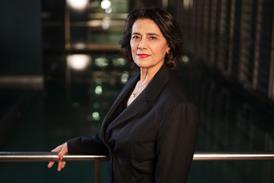
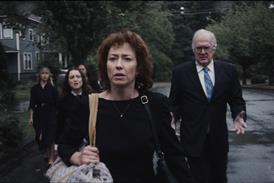
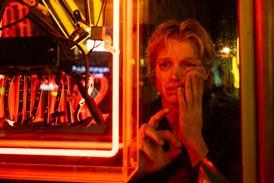







Growing up in Israel, Guy Nattiv loved his grandmother as any youngster would. But it was not until he made The Liberation many years later, loosely inspired by her story, that he got closer to understanding what happened to her after the war, and why the Poland-born Holocaust survivor would eventually abandon the family.
His grandmother struggled with midlife depression when Nattiv was a child in the 1980s, and fell in with an all-female circle led by a magnetic young woman. She had begun attending hedonistic “seminars” and seemed happy. Nattiv and the family joined some of the sessions out of solidarity. “I remember hugging people in the dark and dancing,” he says. “I was a kid. It was a weird situation.”
Nattiv’s family learned his grandmother had been transferring her German Holocaust reparation payments to what was essentially a cult. Then she vanished, separated from her husband, and relocated with the women to a woodland compound on the US east coast. Years later, word got back that she had fallen ill and died.
Tracking the cult
In 2015, years after graduating film school in Tel Aviv and with early features such as The Flood and Strangers under his belt, Nattiv and his American wife and New Native Pictures partner Jaime Ray Newman moved to the US. Newman, with whom Nattiv would win the 2019 live-action short Oscar for Skin, encouraged him to pick up a camera and investigate his grandmother’s fate.
Nattiv visited the compound. “I met these ex-cult members […] and the cult leader that knew me since I was a kid. I started investigating and taking videos.” Eventually the group’s leader asked him to leave, but the trip lit a spark. “She had tried to liberate herself from the Holocaust and the post-trauma,” says Nattiv of his grandmother. He pored over her life’s correspondence and taped Holocaust testimony, and his interviews with the cult members, and wrote the US-set screenplay. “It took 10 years until we got it.”

Naomi Watts was initially cast in the 1980s-set story as the central character Rita Cooper. When she exited, Carrie Coon from season three of The White Lotus and His Three Daughters assumed the role in a haunting performance that puts her squarely in the awards conversation.
“Carrie did a lot of research,” says Nattiv. “She saw my grandmother’s tapes and letters and spoke to my mother and my family. I wanted her to bring herself and she also brought from her own mom.”
UK star Lily James plays Ricki King, the cult leader who offers assistant bank manager Rita the chance to start anew. “She was my grandmother’s best friend and lover,” says Nattiv, who avoids judgment and the clichéd megalomaniacal depiction of cult leaders in his film. “I think my grandmother saw [in her] the mother that she lost in the Holocaust. She relived her twenties.”
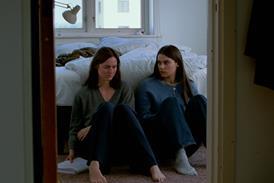
Rita’s husband Reuben is played by Coon’s real-life husband Tracy Letts. Bella Ramsey and Odessa Young, who play Rita’s daughters, had been interested in the project for five years. In the film the young women try to rescue their mother and stay at the compound longer than they planned. The reality was different. “The movie is actually a ‘what if…?’, because my mom and my aunt did want to go and save their mom, but they did not do that,” says Nattiv.
Wild tales
Production took place in late summer 2025 in Vancouver and on Vancouver Island, with an old mill doubling as the compound. “It was so magical and wild,” recalls Nattiv. So wild, in fact, that the production had to evacuate one day due to a wildfire, and kept a constant vigil for bears and mountain lions.
The Liberation premiered at Telluride and has its Canadian premiere in Toronto on September 16. It is dedicated to Nattiv’s grandmother as well as former Bleecker Street founder Andrew Karpen, who died in 2025. “Bleecker were the first on board and it was Andrew’s last film that he greenlit before he passed,” notes the filmmaker. “Andrew and Kent [Sanderson, Bleecker Street CEO] are family to me.”
Image Nation and Spooky Pictures financed The Liberation, and US distributor Bleecker partly financed when it pre-bought the film, and will stage an awards-qualifying run before expanding in January. Embankment Films handles international sales.
“This movie is my love letter to my grandmother,” says Nattiv, who plans to invite his mother to see it at the BFI London Film Festival. “It closes an open wound, but my mother will never be at peace with what happened… I cried on set. Carrie just moved me to the core. This is not only about me, it’s about my whole tribe.”


No comments yet