











Mstyslav Chernov’s follow-up to the Oscar- and Bafta-winning 20 Days In Mariupol immerses viewers into a bloody advance to liberate a village from Russian occupation.
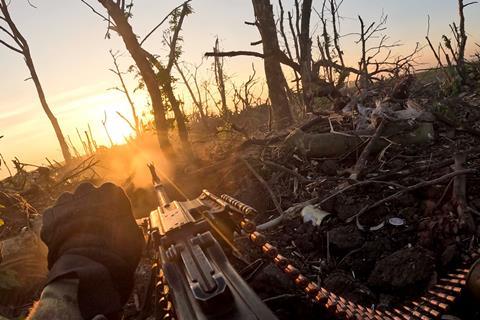
It has been said, on Russian TV channels, that it would take just 24 hours for a Russian tank to reach Berlin, or 20 minutes for a Russian nuclear bomb to hit Washington DC or London. Time slows almost to a halt in 2000 Meters To Andriivka, its progress mired in mud, blood and thick columns of black smoke as a Ukrainian battalion attempts to liberate a village of strategic importance located in the east of the country, near Bakhmut.
This is the second documentary feature by Pulitzer Prize-winning Ukrainian journalist and filmmaker Mstyslav Chernov, whose debut feature 20 Days In Mariupol chronicled the first weeks of the Russian invasion in the besieged port city. Again co-produced by Associated Press and Frontline PBS, 2000 Meters To Andriivka tracks the incremental advance of a Ukrainian army brigade along a narrow corridor of forest.
“It’s like landing on a planet where everything is trying to kill you,” says one Ukrainian soldier of the blasted strip, two kilometres in length, that is fortified by entrenched Russian troops. Charred trees point to a sky buzzed by suicide drones.
“I wanted to make a film about distance,” says Chernov. “And that distance is not just the distance between the beginning of that little forest and Andriivka, it’s also the distance between the Ukrainian society right now and those men who are fighting in a trench, for years. It’s the distance between Europe and Ukraine. I wanted that world of Ukrainian trenches to feel very close to Europe and to the west.”
As the Ukrainian counteroffensive began in June 2023, Chernov found himself touring Europe and the US with 20 Days In Mariupol, experiencing film festival red carpets and receptions. It was a world he would return to later that year and into 2024, as 20 Days In Mariupol built towards its wins at Bafta and Oscar.
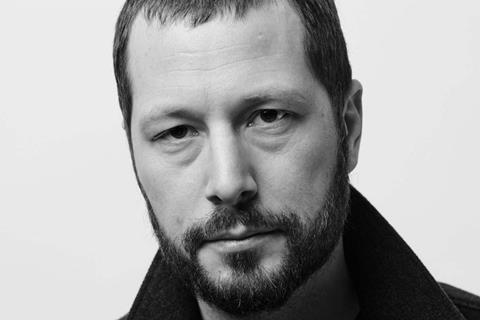
But in the summer of 2023, the pull of his home country was inexorable. Andriivka is just two hours from Chernov’s hometown, and he realised that its small pathway of forest, surrounded by fields and landmines, could symbolise the entire 600-mile frontline if he and his fellow cameraman Alex Babenko might join a platoon. The success of Chernov’s previous film offered access.
“When I came to brigades explaining that 20 Days was a film about how Russians invaded us, how Russians destroyed the lives of civilians and destroyed cities, and now I want to make my second film about Ukrainians taking their land back, they welcomed us,” says Chernov.
Inspired by the structure of Christopher Nolan’s Second World War drama Dunkirk, in which three concurrent timelines (a week, a day, an hour) converge climactically, 2000 Meters To Andriivka toggles between the three-month campaign of the soldiers, and the liberation day of September 16, when Chernov and Babenko join the 3rd Assault Brigade on their dangerous approach to Andriivka. It was the job of Michelle Mizner, who edited 2000 Meters To Andriivka and is among its producers, to entwine the storylines.
“Andriivka is a much more complex film,” says Chernov. “20 Days was approximately 30 hours [of footage to condense into a feature], this one is 150 hours. I have to give all the credit to Michelle, combining all the mediums – the helmet cameras, the drones, the suicide drones, the phones, the normal cameras, the two cameras [trained] on the officers in the headquarters who are observing and commanding what’s happening on the battlefield, and then another camera with the medics that receive casualties. She needed to combine it all into comprehensive storytelling.
“When we solved the structure, then we had to solve the rhythm,” continues Chernov. “As soon as the length of the bodycam footage became too long, or the space between those scenes became too short, we saw audiences detach from the experience. It took us a year to figure out.”
Wider perspective
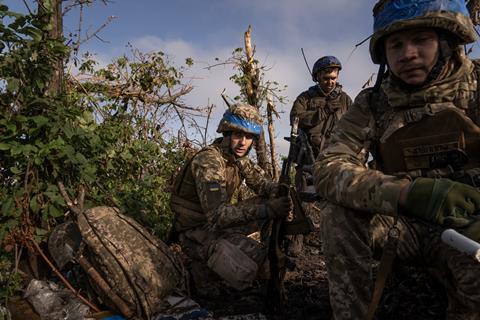
Chernov is careful to keep himself out of the film, maintaining focus on the soldiers. He uses the pauses between bombs to learn of their backstories, to investigate their hopes and fears. A resolute optimism emerges, moving them forward metre by metre, though it is counterbalanced by Chernov’s voiceover. Sometimes a soldier’s story is followed by the telling of his death a few days or months later, and frequently the narration offers a wider perspective on the Ukrainian counteroffensive, tinged with futility.
“I have a responsibility as a journalist, but also as a civilian, to be fair,” say Chernov. “I don’t want to make propaganda films. Audiences are smart. Imagine if I was like, ‘Oh my god, this is great, we’re winning, let’s go!’ Let the public see the strength and sacrifice of those soldiers.”
When the Ukrainian flag is finally raised in Andriivka, it flutters above rubble, the village razed by the retreating Russian army. “What is a flag if not a symbol?” says Chernov. “A flag is just a cloth with two colours, blue for sky and yellow for wheat. But raised over a village it gives hope to a nation. They are liberating names. Yes, you can destroy a village, but you cannot destroy hope.
“The picture of the flag raised over the village is more important than the actual flag raised over the village,” he continues. “Multiply that to the power of cinema, that can preserve that symbol in time. You realise that the village, you can rebuild.”
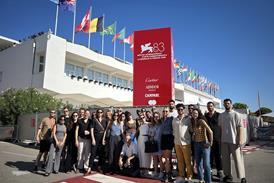
After premiering at Sundance, where it won the directing award for World Cinema Documentary, 2000 Meters To Andriivka screened at CPH:DOX and a swathe of other festivals. It was released by PBS Distribution in North America and Dogwoof in the UK. Chernov again finds himself in the world of red carpets and cocktails, though he is adamant that the importance of awards lies solely in getting eyes on the film.
“There was a huge interest in Ukrainian films at the beginning [of the war],” says Chernov. “Now a film being Ukrainian is almost harmful because people suppose it is going to be propaganda, which it isn’t, and they say, ‘We’ve already seen everything, so why would I watch another Ukrainian film?’”
A third feature is underway, this one located, in part, in the political sphere. “As with any good documentary, we don’t know exactly what it’s going to be about until the last shot,” says Chernov. “My dream is for it to be a film about the end of the war. And it will definitely have a political perspective because that is the focus of the world right now, and that is the perspective that will be interesting to tell, that we haven’t seen yet. But you cannot talk about politics without going back to the frontline or the cities that have been bombed.”
Chernov was in the Oval Office in February when Donald Trump and vice president JD Vance berated Ukraine’s president Volodymyr Zelenskyy for a perceived lack of respect.
“I was in the room,” nods Chernov, “but so were many other cameras. There’s nothing exclusive in that scene. But from a storytelling point of view, I am telling my films from my perspective, so it’s important to speak [to] how it felt. I’m happy I was there, even though it was terrifying, sad and frustrating. But nothing about war is easy or fun, neither in the military or political space.”






No comments yet