










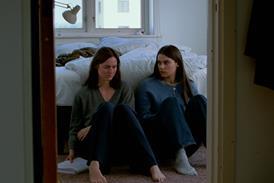

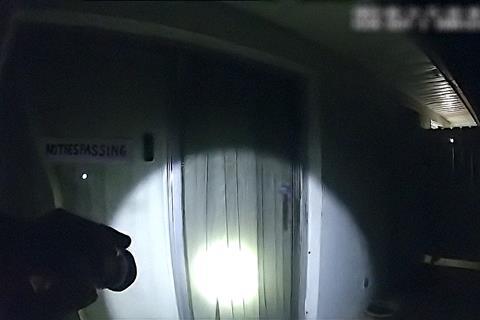
In documentary The Perfect Neighbor, director Geeta Gandbhir uses police bodycam footage, recordings of phone calls to emergency services and other evidence obtained through a Freedom of Information request to piece together the build-up to and aftermath of an incident that occurred in Ocala, Florida in June 2023.
For readers unfamiliar with the case or who have yet to see Gandbhir’s film, please be advised major spoilers lie ahead.
The incident in question had innocuous beginnings. Susan Lorincz, a white woman who lived alone, objected to the children of the predominantly Black neighbours playing in the street and on a grassy area near her house. Her repeated calls to police to complain about their behaviour exacerbated tensions, which came to a head one night when mother of four Ajike Owens came to her property to air a grievance. Moments later, Owens was shot and killed by a bullet Lorincz fired through her locked front door.
Though filmmaker Gandbhir had never met Owens, she knew of her through a cousin of her husband. When the cousin called with news of the shooting, Gandbhir and her husband, producer Nikon Kwantu, leapt into action. “We were trying to support the family and help them mitigate what was happening,” says Gandbhir. “But our role became their media liaison, because there was only one local news station covering the case.”
Using contacts acquired over a long career as an editor, producer and documentarian, Gandbhir was able to get Owens’ mother Pamela Dias on ABC talkshow The View, also securing support from the likes of Reverend Al Sharpton and political commentator Joy Reid. “It was just about organising to make sure the case received the attention it deserved,” explains the director. “We were hoping for some sort of justice.”
Though Lorincz had been arrested, it was uncertain whether she could be successfully prosecuted due to Florida’s stand-your-ground laws, which permit individuals to use deadly force in self-defence if they feel their lives are endangered. “It’s a predatory law because the right to self-defence has always existed in a court,” opines Gandbhir. “Why do we need this additional layer that emboldens people?”
Assembling the footage
The idea for a film crystallised later when the Owens family’s legal team sent a thumb drive of police evidence to Gandbhir and her partners at Message Pictures, the company she founded in 2022 with director Sam Pollard and producer Alisa Payne. It comprised footage from body cameras, dashboard cameras, doorbell cameras and detective interviews, amounting to around 30 hours of material.
“It had come in such a jumble that it was hard for the lawyers to make sense of it,” says Gandbhir, who worked in scripted film before transitioning to documentaries. “They asked us to go through it to see if there was anything that could be used.”
On assembling the footage into a chronological timeline, the director was shocked to find it spanned two years. “To have that much footage leading up to the incident felt unprecedented,” she remarks. “That’s when the idea of a film came to light.”
Eschewing talking heads, dramatic reconstructions and an omniscient narrator, Gandbhir opted to let the footage speak for itself. “We felt the material needed to be undeniable,” she says. “If it was footage that was used as police evidence, we understood it would be seen as unadulterated and unbiased.”
There were technical considerations, however, arising largely from the limitations of the police body cameras. “The footage is meant to be police evidence, not something to be displayed in a theatre or on a platform,” she explains. “It’s not a great recorder, so the sound isn’t always of the highest quality. We had an amazing sound designer and mixer, Filipe Messeder, who managed to clean up the sound and separate it to a certain degree. But we still had to embed subtitles in places where we couldn’t make it decipherable.”
Through footage filmed during police visits to the street where Owens and Lorincz lived across from each other, Gandbhir was able to fashion a portrait of a close-knit community that had grown to tolerate the outlier in its midst. The director was also aware she would be documenting a moment of intense grief and trauma when it came to the night of the shooting.
“We wrestled with what to show,” says Gandbhir, whose film contains footage of Owens receiving medical attention and of her older children being told she has passed. “But we wanted it to be a call to action.”
At one point in The Perfect Neighbor, a sequence showing Lorincz being interviewed by police runs for 20 minutes. Gandbhir, who wanted her film to resemble “a real-life thriller”, believes it was essential that the episode play long. “We wanted the audience to see it in its entirety so they could get the full effect of the conversation,” says the director. “We think our audience is smart, and we trust them to come to their own conclusions.”
The interview exposes damning evidence concerning Lorincz’s actions on the night of the shooting and ends with her being told she is to be charged with manslaughter.
“It’s an uncomfortable scene that plays out in a way that has you on the edge of your seat,” says Gandbhir. “But we wanted the audience to have a gripping experience, so it was important for them to live in it.”
Backed by Park Pictures and SO’B Productions, the film was finished in time to submit to Sundance. That procedure coincided with Lorincz’s trial in August 2024, presenting the director with a dilemma.
“We had never built the film around the trial, as we didn’t know when it was going to happen,” she says. “However, we felt we were cheating the audience by not letting them see it.” Editor Viridiana Lieberman suggested that key moments from the trial – which ended with Lorincz being found guilty by an all-white jury – play behind the end credits, giving audiences both a resolution and a reason to view the film in its entirety.
The Perfect Neighbor’s Sundance premiere saw Gandbhir win the US Documentary section’s directing award, prompting Netflix to acquire worldwide rights for a reported $5m. The streamer launched the film on its platform in October, registering 49 million views by the end of 2025.
The film has nominations at Oscar, Bafta, the Independent Spirits, DGA and PGA Awards, validation Gandbhir believes will resonate around the world.
“It is multilayered and universal,” concludes the filmmaker (who is also Oscar-nominated this year for documentary short The Devil Is Busy). “It’s a film that speaks to laws that exist in the US, but also to greater issues in our global society.”



No comments yet