








Screen talks to director Ugo Bienvenu and producer Sophie Mas about bringing their hand-drawn feature to life
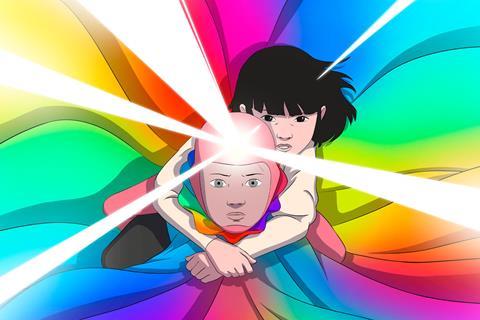
Two-dimensional animated time-travel odyssey Arco has been a five-year labour of love for its dedicated team, after its titular protagonist – a boy with a rainbow cape who falls mysteriously from the sky – appeared out of thin air for writer/director Ugo Bienvenu.
The longtime French illustrator, director, screenwriter, comic-book author, producer, publisher, artistic director and entrepreneur was sitting at home at the height of the pandemic in 2020, doodling in his notebook, when he envisioned “a face emerging from the sky with a rainbow of colours behind it”, he recalls. “That is how Arco was born. I drew him almost unconsciously and, as soon as the drawing existed, the story practically wrote itself.”
Arco is a 10-year-old boy from an idyllic future who steals his sister’s time-travelling rainbow cape and accidentally travels back to the year 2075. There he teams up with a girl and her robot caretaker to help him return home and save the planet.
“I felt like we were living in a bad science-fiction film. I needed softness,” explains Bienvenu. “Everyone was talking about climate change, and said Covid will change the way people act, but I didn’t believe that.”
Many recent films with ecological messages tend to skew apocalyptic, but Bienvenu’s Arco sets itself apart by being more optimistic. “Just because tomorrow may not be as good as today – even worse – doesn’t mean there isn’t a way to create a better world by imagining it, dreaming it and listening to our intuition and our emotions,” he says.
Bienvenu produced Arco with Félix de Givry via their production company Remembers, alongside Natalie Portman and Sophie Mas for MountainA. After a world premiere at Cannes Film Festival last May, it went on to win Annecy International Animation Film Festival’s Cristal awards for best feature film and soundtrack the following month. Diaphana’s October release in France had reached 405,000 admissions at time of writing, while Neon distributed in the US in November. Arco has three European Film Awards nominations, and nods in the animation categories of the Critics Choice Awards and Golden Globes.
From Bienvenu’s initial drawing, he and longtime production and creative partner de Givry began work on the script in 2022, crafting storyboards in parallel. The vision was clear in their minds, but they struggled to find producers who were able to see the potential in a debut feature, hand-drawn in 2D and animated with a small team without outsourcing any production or using CGI.
The duo invested upwards of $350,000 (€300,000) of their own funding in a 40-minute animatic complete with voiceover and music to complement the script. “For three years, we paid for offices and a small team of animators. We invested all of our time and money so this film could exist,” says Bienvenu.
Mas and Portman came to the Remembers studio in spring 2023, he recalls. “We were at the end of our financing, and they swooped in to invest their own money.”
The MountainA pair were immediately struck by the unique animatic. “There was something very artisanal about it, we could see the craft, the poetry and the vision,” says Mas. “It was extremely moving and brought us to tears the first time we saw it.”
Over the next six months, the team created a 90-minute animatic that more closely resembled the finished film, in a race-against-the-clock to be ready to present to Cannes; they showed that version to potential financiers. Arco’s eventual $11.2m (€9.5m) budget, much like the creative process, went right up to the premiere date.
“We were all so sure and so passionate about the project,” says Mas. “We weren’t lying about what we knew we had in our hands, and that translated into conversations with potential financiers.”
Back to basics
Arco uses a minimalist blend of 2D and basic 3D animation tools with key imagery crafted using French software TVPaint. “For me, it’s more about the meaning than the technique,” says Bienvenu. “I see so many animated films that use incredible – and expensive – technology, but I don’t feel emotion. When things take time, it makes them magical.”
The small Arco team gathered at Remembers’ headquarters in northeast Paris for the entire process. “It was like an accordion – there were between four and 200 people working on the project at any given time,” says Mas – a small number compared to the head counts credited in traditional studio animation titles where production budgets frequently exceed $100m.
“It was very natural and friendly,” says Bienvenu. “We worked with my students from Gobelins and Atelier de Sevres [art schools], people I trained and have known for years. We didn’t calculate anything; we relied on our intuition and human talent alone.”
Neon scooped up Arco straight after seeing it in Cannes. From there, the marathon continued with no time for the filmmaking team to catch its breath, since an English-language version had to be ready ahead of its Toronto premiere in September. Neon was involved in the casting process and a casting director was brought on for the roles of the children. But with so little time between Cannes and Toronto, says Mas, “We had five weeks to do everything. We just rolled up our sleeves and called our friends instead of getting agents and lawyers involved right away.”
Those friends happened to be the likes of Mark Ruffalo, Will Ferrell, America Ferrera, Flea and Andy Samberg, alongside Portman. “We were hoping one of them would accept,” says Mas, “and they all watched the film and said yes within the week.”
Beyond the box office and awards season momentum, Bienvenu says: “I receive between 100 and 200 messages per day from parents telling me how the film has moved them and helped them to talk to and connect with their children about different topics, and images of children wearing their own rainbow capes. It’s not just about telling children, ‘It’s up to you to create a better world.’ It’s up to us to prepare it.”
Bienvenu has not set his next project but there are no plans for a sequel to Arco. “The sequel belongs to the audience. It’s up to them to imagine what tomorrow will look like.”



No comments yet