














German actress Nina Hoss, who shines as a star academic in Hedda, tells Screen about playing the gender-switched role in writer/director Nia DaCosta’s fresh take on the Ibsen classic.
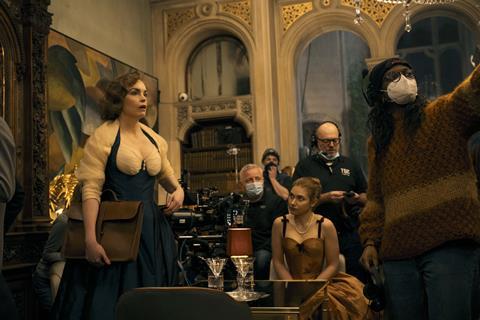
For a long time, Nina Hoss was best known as the chilly mystery woman of German cinema. Between 2001 and 2014, she was the regular lead in Christian Petzold’s films, playing enigmatic, tormented heroines: a Holocaust survivor in Phoenix, a noir-style femme fatale in Jerichow. Given how restrained and sometimes opaque Hoss was in those roles, it comes as a shock to see the Stuttgart-born actress being so utterly flamboyant in Hedda, writer/director Nia DaCosta’s provocative take on a theatre classic.
The feature from Amazon MGM Studios is a radical reimagining of Ibsen’s play Hedda Gabler, with Hoss as a gender-reversed version of Eilert (here Eileen) Lovborg. Eileen is the former lover of Hedda, played by Tessa Thompson; she is a star academic who turns up at Hedda’s extravagant English country house party and, after a few drinks, unleashes her rage at the attendant patriarchy. It is a performance that was spotlighted with a TIFF Tribute Performer Award for Hoss when Hedda premiered in Toronto, and has seen her emerge as an awards contender in best supporting actress (she already has an Independent Spirit Awards nomination).
Hoss’s history with Ibsen’s play began in 2013, having played Hedda for more than six years at Berlin’s Deutsches Theater. “[That production] was a completely different beast,” she says. “My Hedda was going through the decades – we started in the 1890s, when the play is set, then we went to the ’20s, into the ’60s, to the ’80s, to today. Which was a fascinating take on her, because somehow the pressure on this woman didn’t really change.”
In DaCosta’s 1950s-set Hedda, Eilert/Eileen’s gender reversal gives Hedda and her rival Thea (played by Imogen Poots) a new queer identity, while the casting of Tessa Thompson and other Black actors introduces a dimension of racial thematics. “For me,” says Hoss, “the biggest revelation was this gender reversal. Nia never goes out to tell you something or to lecture you, it’s just a fact. These people fall in love with each other, and they happen to be women. You don’t make a meal out of it. The same with the fact Tessa is a Black woman. That’s a statement in itself.”
Team players
DaCosta may be known as a mainstream director, after horror Candyman and superhero adventure The Marvels, but Hoss points out she started out closer to the arthouse with her 2018 debut, crime drama Little Woods, which also starred Thompson. “She and Tessa are an amazing team, and it’s very invigorating when you’re around them. Nia builds the foundation, she offers it to you, and then she’s excited to see what you’re doing. Everything is well thought through – the music, the sound – nothing just happens. Maybe the acting. That’s the one part where things can just happen.”
It is only natural that Hoss’s Eileen comes across as blazingly theatrical. She has a distinguished record as a stage performer and has been a member of two top Berlin-based companies – Deutsches Theater and the Schaubühne ensemble – with roles including the titular lead in Euripides’ Medea.
Since starting out in cinema in the mid-1990s, Hoss has moved easily between stage and screen. She remembers of her first experience in film: “I felt liberated because I had this feeling the camera would come and get what she needs. So, I don’t have to lean into that, I don’t have to think of what I want to tell or do. I just felt very at home.”
Six films by Christian Petzold made her a name internationally, channelling classic Hollywood noir and melodrama tropes, among them Barbara (2012), set in the old East Germany, and Yella, a corporate ghost story that won Hoss the 2007 Silver Bear for best actress in Berlin.
Her collaboration with Petzold, she says, was a very cinephile experience. “Before we started working, we watched the films that he is influenced by in general. They didn’t necessarily have anything to do with the thing we were about to do, just maybe an atmosphere or a style of acting. It was like a seminar to understand the technicality of filmmaking and of acting – how you can use the way you position yourself with the camera. All these kinds of things I started to think about a lot.”
Hoss has worked with several other leading German directors, including Doris Dörrie, Thomas Arslan and Oskar Roehler. She has also made two films with newer name Ina Weisse: Cicadas and The Audition. The latter, in which she played a demanding music teacher, won Hoss the 2019 Silver Shell for best actress in San Sebastian.
Other European work includes a role as the embodiment of European corporate power in Radu Jude’s brittle Romanian satire Do Not Expect Too Much From The End Of The World. She went transatlantic for the first time in 2014 with Anton Corbijn’s John le Carré adaptation A Most Wanted Man, starring Philip Seymour Hoffman, and co-starred with Cate Blanchett in Todd Field’s acclaimed Tár. She has also appeared on TV in Homeland with Claire Danes, and Tom Clancy’s Jack Ryan with John Krasinski.
Hoss says these experiences have allowed her to observe differences between US and European acting styles. “American actors are unapologetic in their choices. If they make one, they make one, and” – she snaps her fingers – “that’s what it is, take it or leave it. We Europeans can have the same thing, but it’s more cautious. It’s a bit more, ‘I offer you something, but you need to come my way as well.’”
Her upcoming film roles continue to bridge the Atlantic. One is The Other Side, with German writer/director Mariko Minoguchi: “A fantastic script, a kind of road movie on foot.” And this autumn, she shoots the mathematics-themed The Julia Set with US director Niki Byrne, alongside Gillian Anderson and Chase Infiniti.
Stage work is likely to remain a continuous thread. Last year, Hoss won plaudits in Chekhov’s The Cherry Orchard, directed by Benedict Andrews at London’s Donmar Warehouse. The in-the-round production, with the actors often seated in the audience, gave the play a special charge when it transferred to New York.
“The tension was high,” she says. “Trump had just got into power, and when you watched this family losing their estate, it was so heartbreaking – to the point that I sat back down in my seat and this woman next to me was just bawling. I had to say, ‘This is just theatre, it’s okay.’”






No comments yet