














French director Sébastien Laudenbach’s animated feature Viva Carmen is based on Georges Bizet’s frequently adapted 1875 opera Carmen, but with a particular focus on the children in the story.
Laudenbach’s challenge was how to “develop a story which does not exist in the opera”.
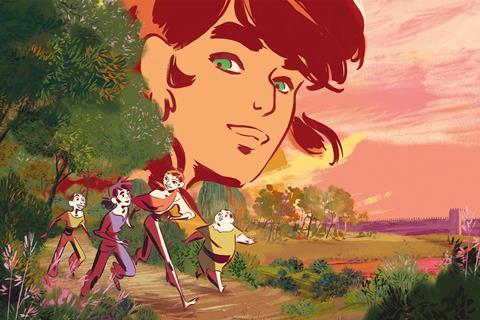
Set in Seville, Spain, in 1845, it follows Salvador, assistant to Antonio, a knife grinder who can see the future. Salvador encounters Carmen, a beautiful gypsy woman, and when Antonio’s visions foretell Carmen’s tragic fate, Salvador and a group of street children attempt to save her.
The film launched in Directors’ Fortnight at Cannes last month, and is now playing in the main competition of the Annecy film festival.
Anatomy Of A Fall actor Milo Machado-Graner and Camelia Jordana are among the voice cast; Global Constellation handles international sales.
Laudenbach spoke to Screen about incorporating children into a story of passion, jealousy and defiance, inventing a new character, and the need for hope.
Why did you decide to adapt Carmen into a film?
Eight years ago I was talking with a friend about the possibility of telling Carmen’s story through the kids’ eyes [the opera opens with a chorus of street children]. It’s only one sequence but it brings a lot of life in the opera. He was wondering if it would be possible to write a Carmen for kids. Then we met a screenwriter, Santiago Otheguy, and we started writing. Then we met the producers Folivari.
Carmen has inspired works by everyone from Cecil B. DeMille to Beyoncé. Did you engage with any of those versions?
It’s a strange proposal, because with the kids’ eyes, you totally change the point of view. We had to write the most important steps of Carmen and Jose [the soldier who becomes involved with Carmen]’s story, but mostly we had to develop the kids’ story, which is not in the opera.
How did you make it include, and be suitable for, children?
I worked for two or three years with Santiago to bring up this proposal, which is Carmen, but not only Carmen, [which is why] the film title is not just Carmen, it’s Viva Carmen, or Carmen L’Oiseau Rebelle in French. It’s a spin-off of Carmen. And it’s for everybody – for families, for kids, for adults. Santiago’s proposals were very important; he creates the character of Belen, and all the end of the film after the death.
In our movie, at the beginning Carmen is a magical archetype of a seductive, attractive woman, but at the end she’s a normal woman with friends, and she dies and is buried.
How do you select your uniquely vibrant colours?
[Production designer] Elodie Remy is the creator of these wonderful colours, and also [art director] Cyril Pedrosa. Elodie starts with little abstract pictures directly based on the script. She coloured the script, and it was the basis for the whole colour process. The shadows were very important, because Seville has very powerful sun, and shadows in the tiny streets.
For Carmen, everybody has their own Carmen in mind, so it was hard to find the right character design. We worked a lot with Cyril and Elea Gobbe-Mevellec [co-director of The Swallows Of Kabul]. We had hundreds of Carmens.
Why was it important to end with a sense of hope?
We’re living in a difficult world, and a lot of women die every day. We can’t change the world with a movie, but maybe we can seed some new ideas about a new civilisation.
But I didn’t only want to make a movie with a message. I wanted to create something alive between the characters, especially the kids.
It was important for me to try to tell the story with failure. It’s quite rare to find a film for kids which has failure. [Typically] when you have a film with kids, they are powerful and succeed. In my movie, they don’t succeed, but it’s important because in life you don’t always succeed.
What are you working on next?
I have another feature film project with Chiara Malta. We are only at the beginning, writing the synopses. It will be produced by Miyu and Dolce Vita Films like Chicken For Linda.




No comments yet