



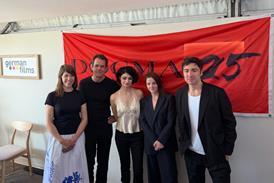

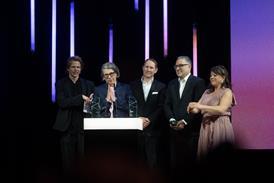

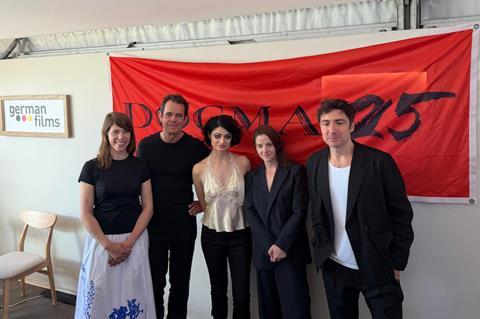
Tom Tykwer, Nora Fingscheidt, Ilker Catak, Kurdwin Ayub and Helene Hegemann have all signed up to a German version of the Dogma filmmaking initiative, unveiled today in Cannes.
The initiative will see each filmmaker make a film under the low-budget Dogma initiative, which has its own set of 10 filmmaking rules.
The German Dogma programme has been put together by Tykwer’s German production company X Filme Creative Pool and its distribution arm X Verleih; Catak’s if… Productions; Denmark’s Zentropa – which formed both the original Dogme 95 and last year’s Dogma 25; Zentropa-formed sales company TrustNordisk; and the Moin Film Fund Hamburg Schleswig-Holstein.
The five directors have signed up to the same 10 rules as those from the Dogma 25 manifesto, announced one year ago tomorrow in Cannes. The full rules are listed below.
Hegemann initiated the German Dogma project last year, several months after the new Nordic version launched at Cannes, along with X Filme producer Jorgo Narjes, who is producing the project with Uwe Schott and Tykwer at X Filme; and Solmaz Azizi, Louise Vesth and Tine Mikkelsen for Zentropa Germany. Catak’s film will be produced by Ingo Fliess.
Hegemann will be the first of the five directors into production. She is starting her shoot in July on a film “about martial arts and dance” despite not yet having a script or cast. “It’s about self defense, on a psychological, physical and political level,” said the filmmaker.
Tykwer and Catak are projecting to shoot their titles this year, at around the same time. Tykwer said his film, which is based on his relationship with his mother, “will be very self-centred.”
“I joked that the 10th commandment [create the film as if it were your last] related to me the most, because I’m the oldest, and it really might be my last film,” said Tykwer. “So I better take care of subjects that I haven’t taken care of in my life, and among them, one of the most prominent is me and my mother.”
Catak says he has an idea “that is still evolving” and is “in the middle of research.”
“I’m going places, meeting people, and that’s a very cool thing, because [according to rule three] you cannot use the internet, so you have to move your feet.” Ayub’s film will come “later”, while The Outrun director Fingscheidt said she “said yes to the process” and expects to be the last of the five to shoot her feature.
“We’re hoping that other countries jump on that train as well,” said Fingscheidt. “It would be wonderful to not just talk about AI in filmmaking, but also to create a counter movement which inspires others.”
The announcement arrives three days after Netflix was announced as a co-financing and distribution partner on all five Nordic Dogma 25 films. Netflix has no involvement in the German Dogma project, which is looking for base financing. X Verleih will distribute the titles in German-language territories, with TrustNordisk as international sales agent. ZDF and Arte are planning to enter as broadcasting partners, with the Moin Film Fund as the first regional funding body.
Isabella Eklof unveiled details on first title Mr. Nawashi at the Five Nordics press conference on Wednesday 13.
THE VOW OF CHASTITY:
I vow to submit to the following set of rules drawn up and confirmed by DOGMA 25:
1. The script must be original and handwritten by the director.
We compel ourselves to write the script by hand in order to nurture the kind of intuition that flows most freely from the dream, channelled through the hand onto the paper.
2. At least half the film must be without dialogue.
We insist on a cinematic approach to filmmaking, because we believe in visual storytelling and have faith in the audience.
3. The internet is off limits in all creative processes.
We commit to produce the films relying on real people within our physical reality – rather than in a digital one infused with algorithms.
4. We’ll only accept funding with no content altering conditions attached.
We assume responsibility for keeping budgets down so the team retains final say in all artistic decisions.
5. No more than 10 people behind the camera.
We commit to working in close collaborations to build trust and strengthen our shared vision.
6. The film must be shot where the narrative takes place.
Film as an art form becomes artificial and generic when we portray a location in a false light.
7. We’re not allowed to use make-up or manipulate faces and bodies unless it’s part of the narrative.
Just as we strive to maintain the authenticity of the location, we also want to portray the human body without a filter. We celebrate it – warts and all.
8. Everything relating to the film’s production must be rented, borrowed, found, or used.
We commit to making films using objects that already exist and renounce the ahistorical and self-destructive culture of consumerism.
9. The film must be made in no more than one year.
We abstain from any lengthy processes that stand in the way of creative flow.
10. Create the film as if it were your last.




No comments yet