















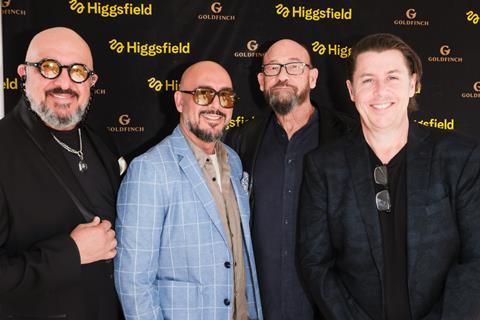
San Francisco-based AI video platform Higgsfield has unveiled the teaser trailer for Hell Grind, billed as the first feature film produced entirely on its platform, during a Cannes industry event hosted with Goldfinch on Saturday, May 16.
The action fantasy, directed by Aitore Zholdaskali and co-written with Adilkhan Yerzhanov, will have its full premiere at Cinema Olympia on May 21, following the private industry preview on the Vieux Port.
Hell Grind follows four street thieves — Roco, Lulu, Jax and Rein — whose failed heist triggers the opening of a portal to the underworld, sending the characters to locations including a Tibetan temple and feudal Japan. Higgsfield is positioning the film as proof that AI video can now support long-form genre storytelling, rather than just short-form social media clips and advertising work.
Alex Mashrabov, CEO and co-founder of Higgsfield, revealed the project was designed to test whether AI was “ready for primetime” and could sustain an entire feature. “We wanted to see if AI can actually democratise access and remove this kind of budget constraint, which limits tens of thousands of creative professionals throughout the world,” he told Screen International.
Value for money
According to Higgsfield, the 95-minute feature cost under $500,000, with most of the budget going on computer costs. The first 25-minute segment required 16,181 video generations to produce 253 final shots, a 64:1 curation ratio. Mashrabov said a comparable traditional action-fantasy feature could cost around $50m.
The film was produced by a team of 15 directors, cinematographers and editors, most of them working in person from Almaty, Kazakhstan with some collaborators joining remotely. Mashrabov explained that the execution phase took around two weeks, although the underlying idea and script had been developed by the filmmakers over several years.
He stressed the film was not conceived as a replacement for traditional craft, but as a way to give filmmakers access to scale that would otherwise be out of reach. “We are not here to compete with anyone,” he said. “We are here to showcase the capabilities, talk openly about the advantages but also about some limitations.”
Those constraints, he added, remain particularly visible in complex scenes involving several characters. “There is definitely a feeling of a slot machine,” said Mashrabov, noting that some shots still require hundreds of iterations before the spatial logic, character placement and action work correctly.
For Zholdaskali, who directed Sicko, selected for Rotterdam’s Bright Future section earlier this year, the project represents a radical compression of the traditional path to feature filmmaking. Higgsfield’s comms lead Dinara Mamleyeva said the director had spent a decade getting his first traditional feature made, whereas AI enabled him to arrive in Cannes with a new project only months after attending Rotterdam.
The script, she said, remained fundamentally human-driven. “Some people might use AI to even write the scripts. But I think we’ll see the difference between AI-generated scripts and human-crafted scripts. Then the audience will decide which one they prefer.”
Hollywood filmmaker Chuck Russell, whose credits include The Mask, Eraser and A Nightmare On Elm Street 3: Dream Warriors, attended the event after viewing early footage from Hell Grind. He clarified he was not involved creatively in the production, but was “an observer and now a fan of the project”.
Russell said the footage marked a step forward for AI filmmaking because it made him respond to the characters. “It’s the first time in AI where I actually found the characters themselves charming,” he said. “I think they reached another level of just entertainment.”
Hybrid approach
Russell was at Cannes with his new company Neumorphic AI, which has entered a partnership with Higgsfield. The company’s partners include producer Sam Khoze, VFX artist Erick Geisler and Anoush Sadegh, with Russell serving as CEO and co-founder. Russell said Neumorphic’s focus will be on hybrid production, combining live actors and traditional filmmaking with AI-generated environments, worlds and visual scale.
“The holy grail is to use our actors and our artists, but to use all the advantages of AI that expands the imagination,” said Russell. He compared the current moment to the early days of CGI on The Mask, when the technology was still unproven and regarded with suspicion.
For Russell, the key is discipline. “AI is a wild horse,” he said. “It will run away with your story if you don’t have discipline and learn how to use it properly.” He added that the human element remained essential: “You need internal logic for the storytelling. And number one, you need the human touch.”
Mashrabov said Higgsfield wants to support an ecosystem of AI-generated films and series, with the aim of helping filmmakers produce work at a pace and scale previously unavailable. “The distribution today defines budget, and budget then defines what the creative possibilities are,” he said. “Our goal is to make sure people don’t give up on their creative choices.”