









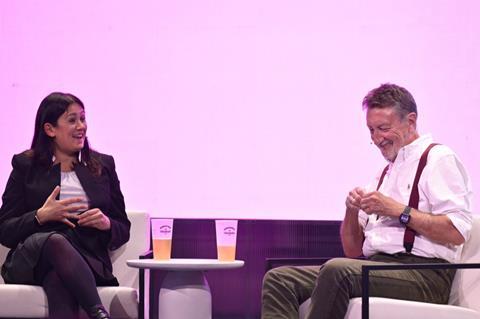
UK culture secretary Lisa Nandy has admitted the UK government “got it wrong” in its approach to AI and copyright for the creative industries.
“I just want to be really clear about where this government sits on it, because we went out to try and find a way to help tech and creative industries to unlock the opportunities of AI, and we got it wrong in the first instance,” said Nandy.
She was speaking during an on-stage conversation with Peaky Blinders and Bond 26 screenwriter Steven Knight at SXSW London on June 1.
In March of this year, the UK government changed its position on copyright and AI, saying it did not plan to introduce an ‘opt-out’ exception to copyright for AI training. The government’s proposed ‘opt-out’ model would have meant rights-holders would have to explicitly say they do not want their work used to train AI models, allowing developers to scrape creators’ work online without active consent.
“We’ve held our hands up and said, ‘We got it wrong.’ You don’t hear that in politics a lot,” she continued. “We’ve reset and restarted that process. Liz Kendall, who is the science secretary, and I are absolutely crystal clear that one of the greatest USPs [unique selling points] that this country has is our creative industries.
“There are opportunities, but there are challenges, and there are particularly challenges for the smaller players who don’t have protection against their work being used in ways that don’t support them to make a living, or in ways that could be harmful.”
The government had previously said the ‘opt-out’ model was its preferred option to support AI innovation in the UK. But it faced an immense backlash from the creative industries, with 88% of 11,500 respondents to a government consultation saying they wanted to see copyright licenses required for all cases when training AI models on existing works.
Nandy said the government is still keen to harness the opportunities that AI could bring to the UK, but has made no decisions on next steps, with industrial consultations still ongoing.
“We’ve brought together tech companies and creatives from across the creative industries, because the challenges facing music are not the same as publishing, they’re not the same as other areas… We’re making some real progress, but I won’t sit here and pretend we have resolved it, because we haven’t.”
She was keen to underline the opportunities that she said can come from the UK embracing AI advancements.
“When I talk to the tech companies, what I hear a lot from them is that when they started with AI, what they wanted was content,” she said. “They wanted a lot of data very quickly to help develop the system. What they now want is quality, and when it comes to quality human content, because the UK is a nation of storytellers, when it comes to music, film, TV, fashion, we are second to none. The UK is a place where they want to do business, so if you get a framework right, this could be really good for the creative industries as well.”
However, Knight added that he felt “AI is a threat to writers… They [AI tech companies] seem to escape from any sort of moral judgment. That’s probably a simplistic way of looking at it. But I think there is an absence of obligation from certain people to do the right thing by the rest of us.”
Streamer investments
Elsewhere in the on-stage conversation, Knight, who is a co-founder of Birmingham studios Digbeth Loc Studios, called for more meaningful investment from the streamers in the UK. Knight has worked with Netflix on film Peaky Blinders: The Immortal Man and series House Of Guinness, as well as Disney+ on series A Thousand Blows.
“What’s happening is the big streamers have come into this country, because it’s the best place [for production], because of the people and the way they’ve been trained,” he said. “The issue for me is they come here, they make big blockbuster productions, that’s great because it’s employment for a lot of British people working in that industry, but all of the profit goes back to the [United] States.
“I just feel there is a conversation to be had about, ‘You’re not shooting in the States, you’re shooting in the UK’, so maybe you leave a bit behind for the British film and television industry… It’s a two-way street, and if you’re going to come and take advantage of what we have, then maybe financially there is a 1% or 2% something that is left behind that helps us to maintain. It is in the interest of the streamers.”
Nandy did not comment on the likelihood of an investment obligation or levy for streamers in the UK in the future but said from her conversations with US executives: “I think there is a strong recognition, actually, that it’s in their [streamers] interest to help build and maintain the ecosystem.”
Knight also threw his weight behind a well-supported and protected BBC. The UK government is currently reviewing the BBC’s royal charter. “The BBC is basically the university of television for the world,” he emphasised.






No comments yet