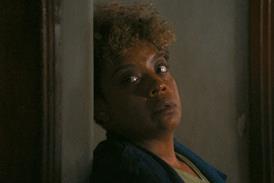

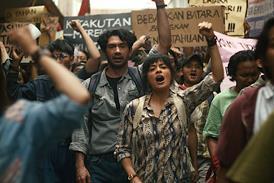






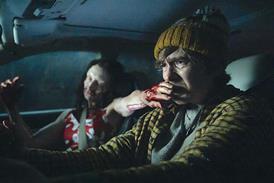




Filipino director Rafael Manue’s enigmatic debut is executive-produced by Chinese filmmaker Jia Zhiangke
Dir/scr: Rafael Manuel. Singapore/UK/Philippines/France/Netherlands. 2026. 100mins
Amost entirely set in an elite country club and golf course on the outskirts of Manila, Filipiñana is a film of great formal poise that hides a discourse about power, patriarchy, corruption and violence beneath a placid surface of sprinklers, golf carts and obssessively tended greens. A rich, densely cinematic film, it is a stunning assured debut from young Filipino filmmaker Rafael Manuel.
Has the precision of a vivid dream
Manuel’s feature-length expansion of his 2020 short of the same name is executive produced by Chinese filmmaker Jia Zhiangke and screens in Berlin Perspectives after winning Sundance’s World Cinema Dramatic Special Jury Award for Creative Vision. Indie distributor Kino Lorber scooped North American rights just as Berlin began, and other deals are sure to follow. It is a film that should be seen in cinemas, but it’s easy to imagine it surfacing on one of the more arthouse-oriented streaming services.
A minibus careening through crowded Manila streets stops to pick up a young woman who turns to the camera, smiles, and teaches us how to say ‘mabuhay’ – ‘welcome!’. A reverse shot reveals that she is addressing a busload of Chinese tourists, on their way to a luxury golf resort. The minibus is held up by a long line of people queuing for water, and we cut to see water in abundance – gushing from sprinklers over the fairways of a golf course that, on one of the hottest days of the year, is blatantly, sinfully green. Another cut reveals the upside-down face of a teenage girl who is lying on the grass under one of the sprinkers. The spurts of water that come between her and us look like scratches on a photo, attempts at erasure.
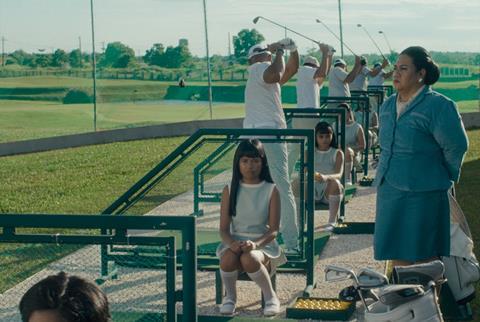
The girl is 17-year-old Isabel, played with calm intensity by Jorrybell Agoto. She comes from the rural Ilocos region, north of the capital Manila and the homeland and power base of the Marcos dynasty; it also happens to be from where the golf club’s somewhat elusive and mysterious director Dr Palanca (Teroy Guzman) also hails. Isabel works as a tee girl. She and the other girls sit on low stools in the stalls of the club’s driving range. Each time a club is swung, inches from Isabel’s knees, we hear an amplified thwack as iron strikes ball – like the machete swish of the sprinklers, this is one of several hyper-real sound design elements. Each time a ball is hit, Isabel replaces it, and tenses up once more.
In this slow dance of a film with little dialogue and plenty for the audience to work out for themeselves, a second young woman gradually emerges, Clara (Carmen Castellitos). On this sweltering day, Clara is playing a round with her smooth uncle, a golfing equipment entrepreneur. He wants her to leave New York and come back to the Philippines to work for him. She is unsure. Though it’s never stated – very little in Filipiñana is – we guess she left to get away from just this kind of subtly coercive pressure to join the country’s ruling elite. There’s a third female character, but she’s a niggling absence for most of the film after being briefly glimpsed at the beginning: a little girl who has wandered away from her maid and is lost somewhere out there on the course.
The resort and golf club is a believable microcosm, not a stretched metaphor. Why would it be any different from the country it exploits? There is a staff hierarchy, with the tee girls – who are told not to venture out onto the course – near the bottom and the older all-female caddies somewhere in the middle. Their proximity to power, however, comes at a price. An early shot of Isabel in the driving range framed between the legs of a male golfer is eloquent.
But Filipiñana is never didactic. Its vision, captured in Xenia Patricia’s limpid cinematography, has the precision of a vivid dream, one in which fallen, fly-blown mangos, diseased pine trees, a group of blind musicians, or the dollshouse-like pavilion where Isabel is given a golf club to return to Dr Palanca seem to exist in some other dimension. Like many dreams, this one is meticulously colour-coded, starting with the caddies’ apricot pink and the tee girls’ baby blue uniforms, and culiminating in the glint of silver on the driving iron that becomes, in the film’s final section, a kind of magic, access-all-areas charm for a girl who has become something of hero.
Production companies: Pototcol, Ossian International, Epicmedia, Easy Rider Films, Idle Eye
International sales: Magnify akennedy@magpictures.com
Producers: Jeremy Chua, Alex Polunin, Bianca Balbuena, Bradley Liew, Nadia Turincev, Omar El Kadi, Rafael Manuel
Cinematography: Xenia Patricia
Production design: Tatjana Honegger
Editing: Rafael Manuel
Main cast: Jorrybell Agoto, Carmen Castellanos, Teroy Guzman, Carlitos Siguion-Reyna, Nour Houshmand, Isabel Sicat