




Kingsley Ben-Adir and Rob Morgan head intimate story of a dementia care programme in a US prison
Dir: Petra Volpe. Switzerland/UK. 2025. 95mins
Desperate to be released from the life sentence he is serving in a US prison, 40-something Frank (British actor Kingsley Ben-Adir) volunteers to join the Yellow Coats, a group of prisoners caring for fellow inmates suffering with dementia. While he initially hopes the role will help his upcoming parole application, Frank soon discovers that the benefits go much deeper. Swiss filmmaker Petra Volpe follows last year’s Late Shift with another intimate drama focusing on the value of human connection in a challenging environment and, while Frank & Louis is narratively unsurprising, its strong performances and emotional authenticity give it undeniable power.
Focuses on the value of human connection in a challenging environment
Making its debut as a Sundance Premiere, Volpe’s first English-language film should draw attention thanks to the international prowess of its director: Late Shift premiered at Berlin 2025 and enjoyed a healthy festival run, was selected as Switzerland’s official Oscar entry and sold widely. With its fresh take on the well-worn prison movie, Frank & Louis should also appeal to distributors and audiences who responded to thematically-similar films like Starred Up or Sing Sing; it has already sold to territories including Germany, Austria, Switzerland and Benelux.
With his fastidiously neat cell, softly spoken nature and passion for making miniature soap carvings, Frank doesn’t come across as a typical inmate. Indeed, Volpe and co-screenwriter Esther Bernstorff work hard to upend genre expectations; what we see of the prison (located somewhere in the US, although the film shot in the UK and Switzerland with a largely British cast) is generally calm and orderly, violence is kept to a minimum. Their focus in on cutting through the toxic masculinity normally associated with stories of incarcerated men – and, particularly, the stigmas around Black prisoners – to find a sense of community and humanity
Yet Frank’s first interactions with 60-year-old Louis (Rob Morgan), who is suffering from early onset dementia, do not go well. Louis is surly, withdrawn and distrustful, and the closed-off Frank has absolutely no idea how to reach him. Slowly, however, he realises that to earn Louis’ trust, he’ll have to let down his guard.
Volpe and Bernstoff have based their story on interviews with real life carers at the California Men’s Colony in San Luis Obispo, and this authenticity informs every aspect of the film. Cinematography, from Judith Kaufman (who shot Volpe’s previous films Dreamland, The Divine Order and Late Shift) is – in contrast to Late Shift’s propulsive energy – measured and observant, taking in the small details, the moments of connection which blossom within this claustrophobic, muted space. Equally as restrained is Oliver Coates’ score, which moves from melancholy to hopeful without ever being overblown.
The cast of central characters is small but vividly-drawn, their emerging backstories giving them personalities that extend beyond their criminality. Ben-Adir and Morgan give balanced, sympathetic performances as Frank and Louis, hinting at the hidden depths and fragile vulnerabilities that lurk below hard-bitten surfaces. Both characters have troubled backgrounds; we learn through Frank’s visits with his sister Trish (Slow Horses star Rosalind Eleazar) that his religious father has rejected him, and Louis has no contact with his daughter. Both men are also avoiding the truth of their violent pasts; Louis because he cannot remember the man he was, Frank because he truly believes he has changed and has earnt some vindication.
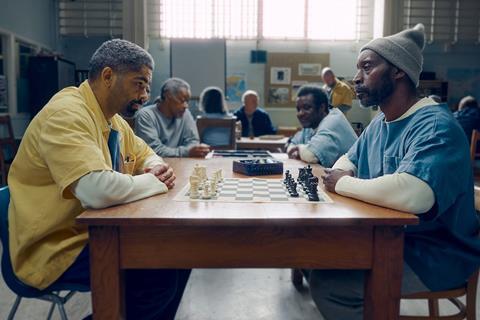
With Louis’ dementia redrawing typical emotional boundaries, it gives Frank the opportunity – and, indeed, makes it necessary – to open himself up. The pair’s growing bond develops not through grand speeches or melodramatic revelations, but small, quiet moments; sharing a meal of instant noodles, playing a game of chess. Through their growing friendship-of-sorts, they offer each other genuine respect and dignity.
That’s not to say that the film excuses any of these men for their past behaviours, or suggests that groups like the Yellow Coats offer any easy fix. A difficult parole hearing disabuses Frank of the notion that his crime can be so easily expunged. One of the prisoners subjects volunteer Julian (Puerto Rican rapper Rene Perez Jogler, excellent) to appalling racial abuse in his moments of lucidity; such men have not been rehabilitated, they have merely forgotten their hate.
Yet Frank & Louis takes care to look past this culture of violence to the green shoots of hope that programmes such as the Yellow Coats can nurture. By learning the value of compassion and empathy, Volpe argues, volunteers like Frank and Julian are able to find strength, purpose and, most importantly, redemption.
Production companies: Caspian Films, Zodiac Pictures
International sales: TrustNordisk, info@trustnordisk.com
Producers: Lukask Hobi, Reto Schaerli
Screenplay, Petra Volpe, Esther Bernstorff
Cinematography: Judith Kaufmann
Production design: Su Erdt, Iain Andrews
Editing: Hansjorg Weissbrich
Music: Oliver Coates
Main cast: Kingsley Ben-Adir, Rob Morgan, Rene Perez Joglar, Rosalind Eleazar, Indira Varma