














Berlin Perspectives title is set around a decaying film production facility and utilises immersive hand-drawn visuals
Dir. Xu Zao. China. 2026. 90mins
Chinese animation is strongly associated with East Asian mythology, yet Xu Zao’s first feature-length work finds creative inspiration in the quotidian matters that usually permeate live-action local indies. Primarily set around a film production facility that has seen better days, Light Pillar uses immersive hand-drawn visuals to illustrate the ordinary existence of a humble, cash-strapped employee, while showcasing the virtual world to which he misguidedly retreats for short-term pleasures.
Entirely heartfelt and genuinely affecting
Blurring the boundaries between animation and live-action, reality and illusion, Xu reflects on the lure of interactive technology as a quick fix for everyday loneliness. Light Pillar is certainly melancholic, but wry humour and a quiet sense of optimism ensure that there is nothing maudlin about it.
Competing in the Perspectives strand at the Berlinale, Light Pillar should prove a breakthrough for Xu, whose 43-minute animation No Changes Have Taken In Our Life was awarded the Golden Dove at DOK Leipzig and the Grand Prize at Japan’s Image Forum Festival. His emphasis on mundanity may prompt comparison to Liu Jian, whose roughly-hewn satirical animations Have a Nice Day (2017) and Art College 1994 (2023) were enthusiastically received on the festival circuit. Xu’s less caustic sensibility and flair for magical realism, recalling early Makoto Shinkai (Suzume), could enable Light Pillar to shine beyond festivals. International sales prospects should be strong, since striking visuals and the universal theme of alienation make it a welcome find for mature animation audiences.
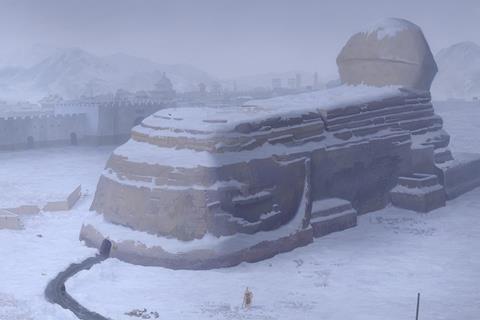
In the distant future, space tourism has become a reality and the demand for traditional entertainment has waned. Consequently, a Chinese film studio, boasting imposing structures ranging from recreations of the Forbidden City to the Great Sphinx of Giza, verges on bankruptcy. During a seemingly perpetual winter, this vast compound is blanketed in snow and eerily vacant.
Lonely caretaker Lao Zha (Da Peng) is one of five remaining core maintenance staff; companionship coming from a cat that once appeared in the films. When the studio owner cannot pay Zha’s salary, he re-gifts a VR headset as partial compensation. Immediately captivated by the virtual realm, Zha is seduced by a female player (Qing Yi) who suggests that they take a real-life space trip. Meanwhile, the increasingly desperate but ceaselessly enterprising owner tries to rebrand the studio as a theme park. When that initiative fails to draw the crowds, only one viable option remains: a legendary director wants to shoot an alien invasion extravaganza with the actual destruction of the studio to be filmed for the big climax.
Ardent fans of cinema from mainland China will likely notice that the fading studio is a beautifully designed composite of Shanghai Film Park and Hengdian World Studios, minus the hustle and bustle. As such, it represents the gradual eradication of shared cultural memory, while the winter season symbolises the stagnation and emotional numbness to which Zha has succumbed.
If there is a suitably awed reverence for the classical design of the studio, its custodians are given appreciably offbeat touches. Zha is agreeably drawn as an awkwardly relatable everyman, but the standout characters are the staunchly formal studio owner – who uses a handheld microphone even when addressing people in close quarters – and the adorable Ghibli-esque cat, which represents the forgotten art of performance.
The film studio also has aspects of Beijing World Park, a leisure attraction filled with miniature versions of international landmarks where Jia Zhangke shot much of his globalisation critique The World (2004). Xu cleverly inverts that film’s literal flight of fancy, in which computer animation was used to illustrate the protagonist’s fantasies. Here, Zha’s real life is presented in animated form as flat and lacking buoyancy, while the use of live-action makes the virtual environment (named ‘Summer Night in a Small Town’) comparatively more dynamic. This VR realm is depicted through fuzzy digital video that adds vibrancy to its simulation of simple park activities (eating ice lollies, watching performers, taking dance lessons). There is initially a sense of innocence to the courtship that occurs since Zha as playing the “healthy and censored” version of the game.
Such hybridity could feel gimmicky, but Xu’s meditation on the appeal of the artificial is entirely heartfelt and genuinely affecting. Chen Xiaoshu’s gentle score perfectly complements the bleak winter aesthetic, with a burst of yearning post-rock providing a euphoric accompaniment to Zha’s imagined journey through space. By fusing poignant observation with poetic vision, Light Pillar exemplifies how Chinese filmmakers can harness animation as a portal to dreams.
Production companies: Fengduan Pictures, La Fonte
International sales: Cercamon, hello@cercamon.biz
Producer: Lu Xiaowei
Screenplay: Xu Zao
Editing: Yang Chao, Xu Zao
Cinematography: Hao Jiayue
Music: Chen Xiaoshu
Main cast: Da Peng, Qing Yi