














Zhang Zongchen’s follow-up to ‘The Last Farewell’ now plays in Red Sea competition
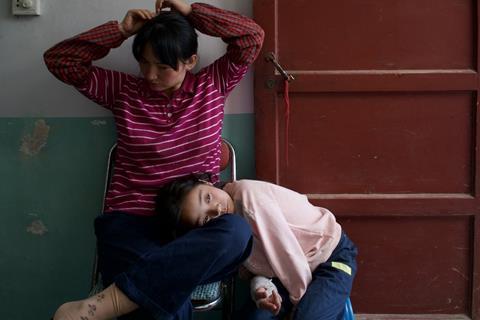
Dir: Zhang Zhongchen. China. 2025. 88mins
Overlooked and marginalised women in rural China are at the centre of Nighttime Sounds, a film that sits comfortably at the intersection of magical and social realism, and surrealism. Exploring the stress of unaddressed needs in women still confronted with patriarchal attitudes and the emotional legacy of China’s recently abolished one-child policy, co-writer and director Zhang Zhongchen’s sophomore effort is a singular visual work. Confident and personal – Zhang draws inspiration from his own childhood in a rural community – it is the kind of film that lingers in the mind.
Zhang brings the lightest of touches
Zhang got a foothold in filmmaking as an editor (he contributes to the cut here) and made waves in 2021 with his debut feature The Last Farewell, about a deaf man discovering his missing father is wanted for murder. Though Nighttime Sounds is more thematically and formally ambitious, that first effort has primed Zhang for more festival play, as has the fact that prominent Taiwanese-Burmese director Midi Z (The Road To Mandalay, Return To Burma) has come on board as executive producer. Further screenings should certainly follow a bow at San Sebastián and a slot in Red Sea competition, and niche theatrical distribution is a possibility in major markets where films such as Vivian Qu’s Girls On Wire or Wei Shujun’s slightly more mainstream Only The River Flows found audiences. A specialty streaming life is likely assured.
Eight-year-old Mao Qing (Chen Halin) lives in rural Maozhuang, a farming village wedged between the dual spectres of history and progress – as embodied by an archaeological site excavating a series of 800-year-old Song Dynasty sculptures and the not-too-distant industrial smoke stacks. With her father away working in the city, the most influential people in Qing’s life appear to be her mother Hongmei (Li Yanxi); Wenjuan (Nan Cui), the local so-called ‘Crazy Lady’ who hears voices; and her grandmother (Wang Lanhua). Hongmei has taken a lover, an electricity lineman (Wang Chaobei), which has brought the village’s judgement and shamed her father.
Qing’s focus changes when she meets another child about her age one day after school. Bai Hai (Gu Hanru) is looking for his lost mother, and it’s possible no one can see him except Qing. Either way, he becomes her friend and confidant, and the gateway through which we discover both Qing and Hongmei’s desires and frustrations – and precisely how marginalised they are as women in China’s disregarded hinterlands.
Zhang loads Nighttime Sounds with images and sounds that illustrate how the weight of the past –personal in the form of Hongmei’s distant marriage and social in the form of the Song statues standing sentinel over the community – presses down on both Qing and Hongmei. Hongmei’s unseen and unacknowledged inner life has her doting on her second daughter Wenwen, often at the expense of Qing, who feels she has to work extra hard to earn her mother’s attention.
Zhang brings the lightest of touches to any commentary on the position Qing, Hongmei and women like them find themselves in. A quiet moment where Qing and her grandmother are flipping through some old photos and reminiscing about her previous work as a midwife decades before speaks volumes when Qing notes there were, “So many babies,” as does the fact that a village wedding ends with the groom declaring he’ll indeed father a son.
Cinematographer Reagon Zhang toggles between expansive, calming images of the green – later brown – wheat fields surrounding the village and intimate, urgent hand-held camera work that works with sound designer from Clark Zhao and Nancy Chen to create the film’s frequently otherworldly spaces. A ghostly floating raincoat suggesting Bai Hai’s presence, whispers that seem to emanate from beneath the statue, mysterious coloured lights in the sky (albeit with earthy sources; all contribute to a language that’s equal parts sorrowful and hopeful.
Through it all Li’s tightly coiled steeliness is a constant reminder of her repressed urges and resented obligations, and her young co-star Chen turns in an intuitive performance that bodes well for her future on-screen career.
Production companies: Beijing San Yue Culture Media
International sales: HKIFF Collection, collection@hkiff.org.hk
Producers: Chen Kunyang, Zhao Yuyan, Xie Jintao
Screenwriter: Li Zhigang, Zhang Zhongchen
Cinematography: Reagon Zhang
Production design: Liane Liu
Editor: Huang Bingjie, Zhang Zhongchen
Music: Retoy
Main cast: Chen Halin, Li Yanxi, Gu Hanru, Nan Cui, Wang Chaobei, Wang Lanhua, Liu Yanju