








Markus Schleinzer’s black-and-white Berlin Competition title also stars impressive newcomer Caro Braun
Dir: Markus Schleinzer. Austria/Germany. 2026. 93mins
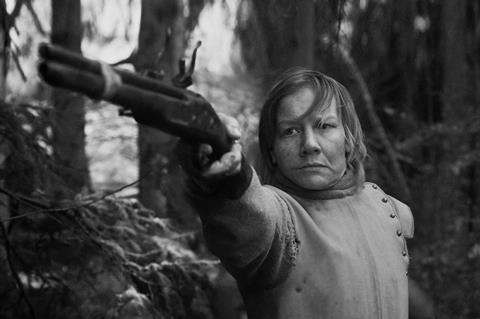
The slight, quiet man who arrives in an isolated farming community in 17th-century Germany has a face that tells a story. Just not the whole story. A former soldier in the Thirty Years War, he has a bullet-scarred cheek and a document that proves that he is the rightful heir to a long-abandoned farmstead. The cautious villagers accept his claim, unaware that the stranger they call “The Misfit” is, in fact, a woman. Rose (a phenomenal Sandra Hüller) learned early on in life that “there is freedom in trousers”.
An elegant, intelligent work
The third film from Austrian director Markus Schleinzer is terrific. What initially seems like a gender-flipped riff on the story of Martin Guerre grows richer and more satisfying as it unfolds. Schleinzer deftly blends droll humour with a poignant portrait of a gender non-conforming individual in a society which is not forgiving of difference.
Following his confrontational 2011 debut Michael, which premiered in competition in Cannes and followed the quotidian details in the life of an Austrian paedophile, and 2018’s Angelo, about an African slave who is raised to be a Viennese ’Court Moor’, Schleinzer’s fascination with outsiders continues. It’s an elegant, intelligent work, but Rose is less austere and unforgiving in its approach than Schleinzer’s previous films. As such, it has real arthouse breakout potential, with Hüller’s name and her knockout performance a key selling point.
Acceptance is a precarious commodity in Schleinzer’s films. For characters like Rose – and Angelo, the eponymous protagonist of his second picture – being part of a community is a privilege which can be abruptly rescinded in response to a misstep. For Angelo, banishment comes when he secretly takes a white woman as his wife. For Rose, a marriage to the initially unwitting Suzanna (impressive newcomer Caro Braun) is just one of the “wicked deeds” promised by Marisa Growaldt’s enjoyably arch narration. Her main crime, however, is her own self-creation. And the punishment for such a grave transgression is severe.
Like Angelo, the film is inspired by a real event: around three centuries ago, a woman was executed in Halberstadt, Germany, for the crimes of impersonating a man and committing sodomy. But this film is not specifically her story, rather an amalgamation of numerous instances of women passing as men which Schleinzer encountered during his extensive research. The resulting screenplay, which Schleinzer co-wrote with Alexander Brom, is one of the picture’s main assets. The film’s distinctive, quasi-poetic use of language is as effective in evoking the place and the period as the picture’s earthy, characterful production design.
Rose is a strikingly handsome picture, but not one that treats its period setting as a museum piece. Peasant existence is simple, God-fearing and authentically grubby. Schleinzer reunites with his regular cinematographer Gerald Kerkletz, this time shooting in an arresting black and white; a canny decision that tones down some of the distracting visual drama and prettiness of the stunning location in the Harz region of northern Germany. Schleinzer and Kerkletz give the story plenty of space, favouring long takes and restrained mid and wide shots.
What’s perhaps unexpected, in a film that has the look of a brooding fable by Carl Theodore Dreyer, is how funny it is at times. Rose’s marriage, arranged as a means to gain access to more land, is fraught with potential problems. Nonetheless, Suzanna soon (too soon) manages to present her husband with an heir. Hüller’s bemused scowl as she processes the news of her impending fatherhood is glorious. And Suzanna, giddy with relief at engineering a cover story for her pregnancy, is a gauche joy. For a moment, it almost looks like they might just make a go of it together. But the patriarchy tends to be touchy about certain things: ownership of land and of penises are both high up on the list.
Production company: Schubert, ROW Pictures, Walker + Worm Film
International sales: Match Factory info@matchfactory.de
Producers: Johannes Schubert, Philipp Worm, Tobias Walker, Karsten Stöter
Screenplay: Markus Schleinzer, Alexander Brom
Cinematography: Gerald Kerkletz
Production design: Olivier Meidinger
Editing: Hansjörg Weissbrich
Music: Tara Nome Doyle
Main cast: Sandra Hüller, Caro Braun, Marisa Growaldt, Godehard Giese, Augustino Renken