











Juan Pablo Sallato’s impressive feature debut takes place at the beginning of the Pinochet regime
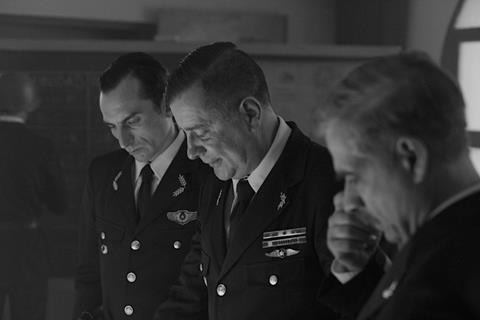
Dir. Juan Pablo Sallato. Chile/Argentina/Italy. 2026. 82 mins.
Films about modern history have an unsettling way of becoming increasingly relevant to the moment in which they are made. Set in 1973, at the very outset of the Pinochet dictatorship, Juan Pablo Sallato’s Berlin Perspectives title The Red Hangar addresses an issue that is now ever more pressing worldwide – the moral challenge of authoritarianism, and how free individuals might respond.
At once impressionistic and very precise
Based on true events, Sallato’s black-and-white drama is at once impressionistic and very precise; this, together with its concise running time, makes for a taut, intense portrayal of one man’s moral and existential crisis, unfolding in what feels close to real time. Centred on a subtly elusive but altogether magnetic performance by Nicolás Zárate, the film should establish documentarist and series-maker Sallato as a first-time fiction director, and attract niche distributors attuned to aesthetic rigour and political seriousness.
The action begins on September 10, 1973, the day before one of the most ignominious dates in South American history. The setting is a Chilean Air Force base in Santiago, a training centre for pilots and parachutists, where Captain Jorge Silva (Zárate), formerly head of Air Force Intelligence, is now in charge of training cadets. When we first meet him, the taciturn captain is inducting a young sergeant (Aron Hernández) who longs to be a parachutist and worships Silva – a national hero thanks to his famous high-risk dive straight into a football stadium.
The very next day, Chile is shaken by the coup that establishes the military junta. The violence begins immediately: the hard-line Colonel Jahn (Marcial Tagle) takes over the base as a centre for the interrogation of those opposed to the new regime. One hangar becomes the site of brutal treatment for the many citizens rounded up, a summary execution signalling the new order. Jahn assigns Silva to interrogation duty – an act of personal revenge, since Silva is known for his loyalty to now-deposed president Salvador Allende, and is therefore a marked man. As an officer sworn to follow orders, Silva has his code of duty, but he will also have to follow his moral promptings under testing circumstances.
Scripted by Luis Emilio Guzmán, the film succinctly and with intense control conveys a sense of events happening in a nightmare rush in a world that has changed literally overnight. Zárate’s performance, initially opaque, gradually reveals Silva’s personality and motivations. First presenting him as a cold-blooded military man, Zárate shows Silva as impatient, then generous, towards his gauche young sergeant; tender and solicitous towards his wife (Catalina Stuardo), a history teacher whose own left-wing affiliations place her, like so many, in jeopardy; and calmly implacable in his dialogue with the new command.
Brief interludes, showing a hallucinatory descent through clouds, give a visual evocation of Silva’s metaphorical fall to earth – his demotion following a crucial act of whistleblowing that his new superiors can never forgive. Diego Pequeño’s superb black and white photography begins by mapping the base, its brutalist buildings and the space of the hangar itself, as yet an empty stage for the theatre of cruelty to come. Later, the imagery ranges from those broader vistas to highly textured close-ups of faces and hands; these allow us to measure Silva’s restrained, often barely readable shifts of thought and feeling behind the composed mask of a career officer.
When it comes to the violence perpetrated – both at the base and at Santiago’s National Stadium, which became a notorious detention centre – Sallato and Pequeño adopt a strategy very similar to that of Laszlo Nemes in his Holocaust drama Son of Saul: he lets us see and hear just enough to know what is happening, eliding any graphic depiction of brutality. A crucial turning point in the last stretch leads to the hangar door closing onto a black screen, followed by captions that outline subsequent real events – making us realise that Sallato’s achievement has been all the greater in eschewing demonstrativeness for a masterfully sustained exercise in oblique realism.
Production company: Villano
International sales: Premium Films/MPM Premium, sales@mpmpremium.com
Producers: Juan Ignacio Sabatini, Juan Pablo Sallato
Screenplay: Luis Emilio Guzmán
Based on a book by: Fernando Villagrá
Cinematography: Diego Pequeño
Editors: Valeria Hernández, Sebastián Brahm
Production design: Nicolás Grum
Music: Alberto Michello, Matteo Marrella
Main cast: Nicolás Zárate, Boris Quercia, Marcial Tagle, Catalina Stuardo, Aron Hernández, Francisco Carrasco, Juan Cano