










Screen gathered Harry Lighton, Akinola Davies Jr and Daisy-May Hudson for a conversation about their first features
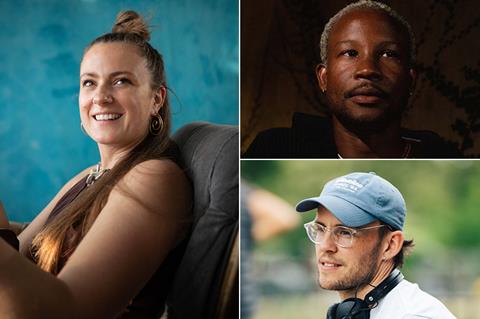
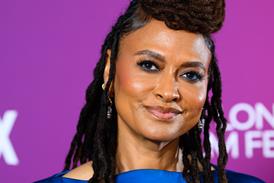
UK directors Daisy-May Hudson, Akinola Davies Jr and Harry Lighton are having the time of their lives. Their first fiction films have lit up the international festival circuit and are now firmly in the awards season conversations.
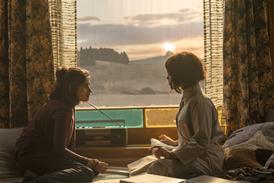
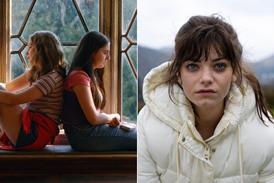
Released by MetFilm in the UK, Lollipop is Hudson’s second film, following 2015 documentary feature Half Way. Produced by Parkville Pictures, the drama stars Posy Sterling as a woman fresh out of prison fighting to find a home for – and then regain custody of – her children. It launched in competition at Edinburgh International Film Festival in 2024. Hudson is also co-director with Sophie Compton on new feature documentary Holloway, about six former inmates of a female prison.
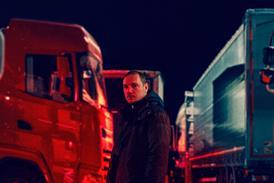
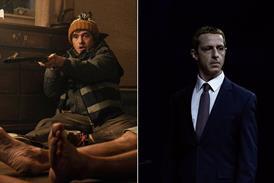
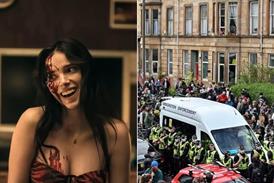
Davies Jr’s My Father’s Shadow and Lighton’s Pillion both debuted at Cannes 2025 in Un Certain Regard. Mubi UK release My Father’s Shadow stars Godwin Egbo and Chibuike Marvelous Egbo as two young brothers who spend the day with their long-absent father (Sope Dirisu) in Lagos during the tumult of Nigeria’s annulled 1993 presidential election. Written by Wale Davies and co-written by Akinola, it’s produced by Element Pictures with Lagos outfit Fatherland and the UK’s Crybaby.
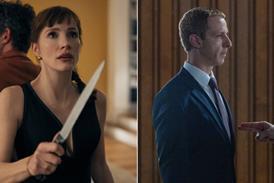
Lighton’s Pillion stars Harry Melling and Alexander Skarsgard in a comedy about a BDSM gay relationship in south London. It’s also produced by Element, and distributed in the UK by Picturehouse Entertainment.
The trio came together ahead of British Independent Film Award wins for their films including best breakthrough performance (Lollipop), director (My Father’s Shadow) and debut screenplay and film (Pillion).
Daisy-May, tell us about making Lollipop.
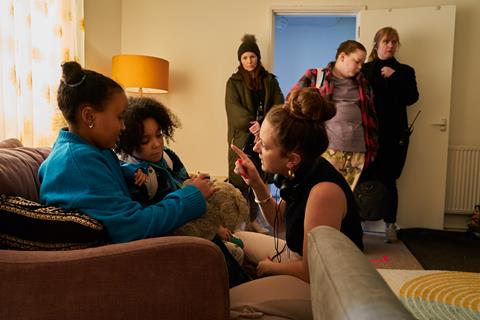
Daisy-May Hudson: After Half Way, the producers asked me if I’d thought about writing something [fictional]. I’d started filming these amazing women who were fighting for their right to get their children back. But I don’t like putting real women on screen as victims or in the middle of personal trauma. Whereas, if I could write it [as fiction], then I could write some levity in, and I could protect the women. I started Googling ‘how to write a film’. I didn’t go to film school.
Harry Lighton: I didn’t either. I did the same as you, I did the Google.
Akinola Davies Jr: I did a filmmaking workshop, which was very basic.
Hudson: But everything I was reading just didn’t resonate. I’m not a thinker, I’m a feeler. I started writing streams of consciousness, pulling from my own experiences and from research. The writing process took five years and I was supported by BBC Film and the BFI. Suddenly, it was, “We want to make it, and we’re going to make it in three months,” which was such a change in pace. [I had] a lot of imposter syndrome. I had to go through some phases of self-doubt.
How did you overcome that?
Hudson: [BBC Film head] Eva Yates said, “We wouldn’t be giving you the money if we didn’t believe in you.” I was lucky the producers always wanted to make me more of who I am, rather than try to fit me into a box. [They said], “Bring more of yourself on set, bring more of yourself into the script.” There’s so much you can’t control on set. You can spend six weeks in prep, and then on the day, it all falls apart. I learned a lot about surrender and being open to the present moment.
Davies Jr: I have a close collaborator who happens to be my older brother [Wale]. I tend to have meltdown moments and he’s really composed. He’s like, “It’s fine, you can do this. We can do this.”
I care less about outcomes and more about process. If you can be grounded and present in the process, that’s what’s more important, because you’re making stuff with a group of people who all believe in you for some reason or another.
Hudson: I love what you’re saying about the creative process because so much of the industry is about the end product, and questions like “How is it going to be received in the world?” For me, it’s the best energy in the world to work with that creative lifeforce where you’re in that present moment. You’re with everyone that cares about that story, and everyone’s dancing together in this moment that will never happen again.
Lighton: I’m a very neurotic person generally, and a highly neurotic writer. Eva Yates, again, and then my producer Emma Norton ended up being, like, “We can’t give Harry notes, because we’ll say one line on page 72 is wrong, and then he’ll go back and change the setting to an entirely different country and move it a few hundred years back into the past.”
Something I did to try and combat [imposter syndrome] was to go and work as a director’s assistant [with Oliver Hermanus on Living]. I had worked on short film sets but I hadn’t worked on a bigger setup.
Davies Jr: I asked my agent, “Is it possible to shadow directors?” I shadowed on a TV show, and then a couple of feature films. I saw a big director being really chilled with his crew, open and engaging. And I thought, “Okay, you don’t have to be a horrible person. You can just be a normal person, and it can be chaos.”
Lighton: Did either of you seek counsel on how to work with and get performances from kids? That’s something that terrifies me. I’m so impressed by both of your films.
Davies Jr: People are terrified of kids because – maybe this is a terrible analogy – they feel sort of wild. You can’t really box in a kid. You can’t forecast how a kid’s going to behave in any situation. But they’re just little human beings. You have to talk to them with the same level of respect and not talk down to them. More times than not, kids already get it. They come with ideas, and they surprise you. I would also say casting the right kid helps. Don’t cast a kid based on vibes. Cast a kid who really wants the opportunity and who understands the context of where they are.
Hudson: I agree. Kids live in the world of imagination. They’re made for this. As adults, we’re so scared of that ability to be totally present. We worked with Tegan-Mia [Stanley Rhoads], who played Ava, and Luke Howitt, who played Leo, and they brought so many ideas.
I was really careful because I work in a trauma-informed way. There are levels of story that I want to share with them, things to hold back, but they read between the lines anyway. It’s about creating a space for them to feel free. Sometimes that’s the absolute opposite of what film crews are used to. But it makes everyone so much more present.
Harry, you were a first-time director working with an established actor in Alexander Skarsgard. Were there specific challenges?
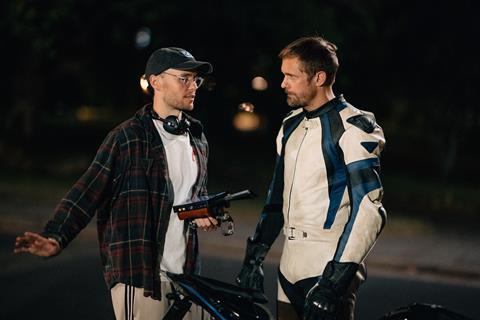
Lighton: As soon as Alexander said yes, I started feeling a bit panicky. I was told he’d only be able to arrive a day before we started shooting. I like to know someone before I work with them. But he went out of his way to make me feel comfortable. He was coming through London for a wedding, and he invited me to an Arcade Fire concert. We spent the night having a few beers. I’d been given all these questions by production because it was the only time I was going to get to chat to him. He was trying to boogie, and I was in his ear, being like, “And what about this costume?”, trying to show him photos on my phone.
Davies Jr: I was terrified of working with Sope. But then you’re faced with reality and Sope is just a wonderful human being who was willing to throw himself into the role and learn two languages and mentor these boys.
Daisy-May, how did you cast Posy Sterling?
Hudson: [Casting director] Lucy Pardee showed me a short film that Posy had done for [women’s prison theatre group] Clean Break. She was playing a pregnant woman. I watched her and got goosebumps. I had a gut feeling that she was the one. When I went into the casting, I was sitting down in the chair, and suddenly felt like I literally didn’t even know what happens in the casting or how to talk to people. Lucy led the first one and then I started speaking up. And then I realised, it is just about chatting to people on a different level, and me and Posy just clicked.
I did a lot of rehearsal, especially with the main cast. I had shadowed Sophie Hyde in her rehearsal period for Good Luck To You, Leo Grande. I saw how much care and attention and love she put into making the actors feel safe and creating that bubble around them.
I did acting classes before going on set so I could tap into the vulnerability of what they’re feeling. It was excruciating – not my bag but I wanted to feel what they felt.
The BFI allowed me to do a three-day workshop, kind of like a camera test, but I ended up going deep with the actors into the script and working from the body out. We built that depth of connection. It was about creating the space for people to be more of themselves and to bring more. I’m also a shamanic healer, so I bring all those elements into the rehearsal process. Working with sound and somatics and the body and leaning into what I know rather than what I’ve read in books.
That sounds incredible.
Hudson: Yeah, it’s deep. What people will realise now if they’re going to work with me is that I’m going to go into their soul. But in a good way. One day when we were doing a really impactful scene, it got me, and I had to pull everyone together and say, “This is a scene that touches deep places within me so we’re going to have to go slow.” And by me saying that, someone else said they had lived experience that crossed over with this. Suddenly we’re in this shared vulnerability where this has meaning for everyone. That’s a good place to be. The more open I can be, the more open everyone can be.
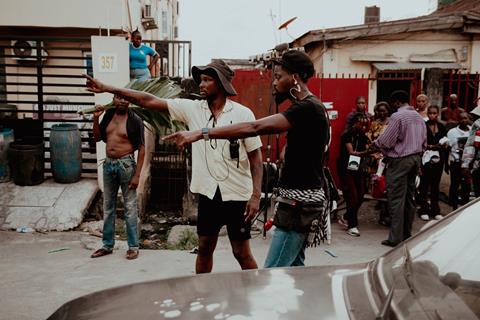
Davies Jr: Completely. I want the crew to pipe up, I want them to feel like they own it as much as I do. I don’t like hierarchy on a set. I’m of the opinion that the best idea wins. And gratitude – I think a lot of crews don’t hear that as much as they should, how good they all are.
Who inspires each of you?
Hudson: I love Kathy Burke and [TV shows] Gimme, Gimme, Gimme, and The Royle Family, written by Caroline Aherne [and Craig Cash]. They are about very British, well-observed, real people who are never romanticised, but stay within their own truth. I was also inspired by Nil By Mouth by Gary Oldman. That opening scene where he’s trying to get ice in his drink. I’m like, “I’ve seen those characters 50 million times in the pub.”
Going into Lollipop, it was the time Capernaum was coming out. Nadine Labaki had cast real people and got some of the best child performances. I got obsessed with Capernaum, and how she had remortgaged her house to make it. I felt that kind of all-consuming dedication [to Lollipop].
Lighton: There is a photographer called Nick Waplington whose photos have one foot in reality and one foot on another side of the fence, where there’s a bit of surrealism and a bit of new possibility. They make you think about what could be. I wanted Pillion to exist in that world where there’s a real sense of community, but the ways in which people behave are thought-provoking.
Davies Jr: To something Daisy-May said earlier, I love things that make me feel – music, film, random experiences on the street, text messages, memes, whatever. To live in this body and to be human is to acknowledge the fact we can feel and live and breathe, and this experience is completely unique for all of us as individuals.
Daisy-May, how are you navigating this moment and talking about Lollipop again? Are you able to find the space to think creatively about your next project?
Hudson: I came straight out of the Lollipop edit into the Holloway edit. I didn’t have a day off. That was supposed to be a three-month edit, so I thought, “Okay, I’ll rest after it.” And then it became a year. When Lollipop came out in Edinburgh, it was beautiful and amazing. I could feel 50% of it, but the other 50% I was numb. I realised it was burnout. I spent the next few months deep-diving into myself, giving myself time. I was very fortunate that my partner could support me to take that time off. Now I’m super energised. I just did a short film commercial and I’m feeling that present-moment creativity. I’m ready to go back into writing.
Harry and Akinola, you’ve both had a very intense period since Cannes and now awards season. Are you thinking about your next projects?
Lighton: I am hungry to get cracking. I’m searching around for an idea. So far, I have 25 titles I think are good and no idea [attached] to them at all. I saw a Metro [newspaper] article today called “Angry goat on a roof”. And I thought, “That’s quite a good title for a film. Is there an idea there?” Clearly, I’m not firing creatively on all cylinders.
What I like doing is writing films for other directors when I don’t have an idea myself. I’ve got one of those, which I’m just starting to write, and I’ll try to work out what I want to direct myself at the same time.
Davies Jr: I’m slightly different. It’s taken 15 years to get to this point, and during that period, there were moments where all I did was work. I realised I didn’t really like the person I was becoming.
I’ve always prioritised rest. So after Cannes, I took two weeks off and went on holiday to somewhere I’ve never been before, a place where I don’t speak the language and didn’t know anyone.
I just love being at home. I love laying on my floor. I love being on the ground and just watching random things on YouTube. But I love shooting. I love making films. I love being around crews. I haven’t had the opportunity to do that a lot this year.
For my next film, I have a collaborator, my brother, and my producer Rachel [Dargavel], and we have a bunch of films we’d like to make. We are trying to figure out what feels more urgent, what really speaks to us at this point.
Hudson: I’m feeling so much community. I always believed the industry was so competitive, but the filmmakers I’ve been meeting or know, everyone just has love for each other.
Do any of you have US agents now?
Lighton: Yes, I do, because of this writing gig. It was being set up by a US company, so I needed someone to do the contract.
Hudson: You’re so fancy, Harry.






No comments yet