“I told my wife not to bother coming over because it wasn’t going to win,” says Marsh.

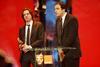
James Marsh (left) and Simon Chien receive the Bafta for outstanding British film for ‘Man On Wire’

Director James Marsh and producer Simon Chinn won the Bafta for outstanding British film in 2009 for documentary Man On Wire against strong competition: Slumdog Millionaire, In Bruges, Mamma Mia! and Hunger. Their film about daredevil Philippe Petit’s 1974 high-wire walk between New York City’s Twin Towers went on to win the documentary Oscar.

Marsh and Chinn teamed up again for 2011 feature Project Nim, and are currently executive producing an HBO doc series. Marsh won another best British film Bafta in 2015 for The Theory Of Everything, while Chinn won a best documentary feature Bafta and Oscar for Searching For Sugar Man in 2013.

How did you feel ahead of the Bafta ceremony?

James Marsh: Genuinely, Simon and I didn’t think we had any hope.

Simon Chinn: That’s my abiding memory too. I thought we had no chance. There was no documentary category in those days.

Marsh: Given the competition, we thought we were just going to show up and have a drink or two and that would be the end of it. I’d just moved to Copenhagen, and had told my wife not to bother coming over because it wasn’t going to win. So she didn’t come, which was pretty sad.

How did you feel when your name was called that night?

Marsh: Stunned, it was a genuine, euphoric surprise. I remember looking at Simon in dis­belief. I remember Simon’s disbelieving look, too.

Chinn: Looking back at the recording on the TV, I remember noticing how utterly shocked and nervous I looked [on stage].

Where did you go after your win?

Chinn: This was my first film. So I wasn’t on the guest list to, like, the Weinstein party [which in retrospect was] definitely not the party to go to anyway. In 2009 a lot of the film studios had parties in Grosvenor House. I went to one or two of those. I remember trying to engage with Steve McQueen, who was in his kilt. And struggling. He wasn’t that interested in me.

Marsh: I remember you waving your Bafta at Danny Boyle at one point, taunting him – you’d had a few drinks. We couldn’t quite claim to have vanquished Danny Boyle because they did win best film.

How did you find the awards campaigning?

Marsh: It was a different world then, a bit more innocent, both for the Oscars and Baftas. I didn’t campaign or go on awards season junkets. That didn’t exist.

Chinn: Our [US] distributor Magnolia were cheap, to be perfectly honest. For the PGA Awards, which we won for Man On Wire, Magnolia wouldn’t pay for my trip. I struggled to get anyone to pay for my trip to the Oscars.

What is your advice for nominees on the awards circuit?

Chinn: Try and enjoy it. It can be stressful and can get a little unseemly, but the success of Man On Wire literally begat our next film. The financing came together rather effortlessly.

Marsh: There is something shameless about it – it doesn’t sit well with me. That said, it does have a real value. It was a turning point in my professional career, both the Bafta and then the Oscar. Awards can change the perception of you as a filmmaker.

Chinn: I had the awards experience again with Searching For Sugar Man a few years later. In that particular case, the director [Malik Bendjelloul] died [by suicide] a year after the Oscars. For him, the experience of scaling those heights was incredibly challenging. Success is wonderful, and it can change your life for the better, but it definitely has a cost.

Did you think Man On Wire would be such an awards success?

Chinn: I had hopes and dreams, but no expectations. It all happened very organically. There was no great fanfare around the film, even at Sundance. We went there with very low expectations, but came out with two prizes and five distribution deals.

Marsh: I found out later that we scraped into Sundance. People worried whether the reconstructions in the film were appropriate to a documentary. They gave us the worst possible slot, in the worst possible location, after everyone had gone home for the weekend. We had no publicist. It was a genuine word-of-mouth achievement.

After winning the Bafta, how did you feel going into the Oscars by comparison?

Chinn: Deeply uncomfortable, but mainly because we were by then considered to be frontrunners.

Marsh: We had been to a few of these awards events, and I was getting this growing sense of people resenting us [for winning]. There was just a feeling of huge relief when we won.

Chinn: Yes, the difference was feeling shocked and elated for the Baftas, versus feeling just huge relief for the Oscars.