






Screen talks to the directors of The President’s Cake, Orphan, The Left-Handed Girl and The Love That Remains, which all showcase child protagonists.
The President’s Cake (Iraq)
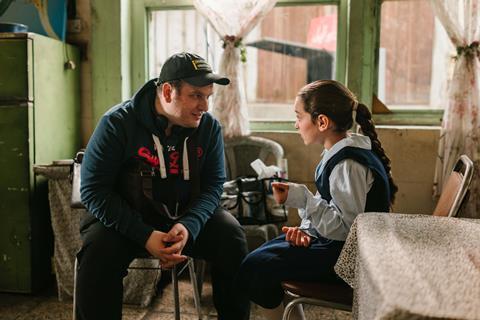
Set in the 1990s, Hasan Hadi’s debut feature The President’s Cake is the story of nine-year-old Lamia from an impoverished family in the marshlands of Iraq, who is instructed by her schoolteacher to bake a cake celebrating Saddam Hussein’s birthday. The task is a challenge: at the time, selling flour, sugar and butter in the sanctions-hit country was illegal.
The Iraq-US-Qatar co-production premiered in Directors’ Fortnight at Cannes, where it won the Camera d’Or, and is now competing as Iraq’s entry to the international feature Oscar. Sony Pictures Classics acquired the film for North America and several other markets, with Curzon releasing in the UK.
The President’s Cake features a cast of untrained actors, and taking the lead are two youngsters: Baneen Ahmed Nayyef as Lamia and Sajad Mohamad Qasem as her best friend Saeed, who joins the adventure around the city.
Hadi was keen his lead actress came from the rural marshland area where he grew up and the character lives, but it was no easy task finding a young girl to play her in a remote part of a country with little western influence.
“There are no drama schools in Iraq so we visited every school, mall, store, sports club,” recalls Hadi. “Looking at kids in public could be a bit creepy [so you have to be sensitive], especially with girls. We couldn’t just send them a script and ask them to come in for an audition and they come prepared – [Iraqis] don’t understand that process. It’s a leap of faith because they’re not sure what we’re selling and we’re not sure what we’re buying.”
Hadi found Qasem while he was location scouting in Baghdad. “The way he approached us and talked to us really felt like the character of Saeed. He disappeared but [when] we found him, we invited him to the office and asked him to recount a dream he’d had. That told me he could access so many emotions.”
Nayyef was the last to be cast. “Her parents didn’t accept it at first – the unknown is the biggest enemy. We explained exactly what we were doing and they eventually became big supporters of her,” says Hadi.
The director held several weeks of workshops with the young pair, instead of rehearsals. “I didn’t want actors,” he says. “The workshops were designed to build trust between us, and also to see how capable they were to access their emotions.”
Hadi also had to find new ways for the leads to learn their dialogue. “One of them couldn’t read but was very good at memorising lines so I got them to understand what was happening in the scene,” he says. “In the workshops, I said that nothing they did was wrong, so if one said the [wrong] line, they should continue. That gave them freedom so when one forgot, the other felt okay to carry on. As a writer, I had to adapt to that reality, I had to make lines closer to how they talked. It had to be organic.
“They were smart, you couldn’t talk down to them,” continues Hadi. “Sometimes they could be emotionally vulnerable and you can’t misuse that because once you lose their trust, that’s it. As long as the shoot is adventurous and fun, they’re in it, but once it feels like a job, they get bored. They don’t care about fame or money. Adults are thinking about festivals but kids are just thinking, ‘I want to go home and play on my bicycle.’ Sajad disappeared so many times. I didn’t have grey hair before this.” – Patricia Dobson
Orphan (Hungary)
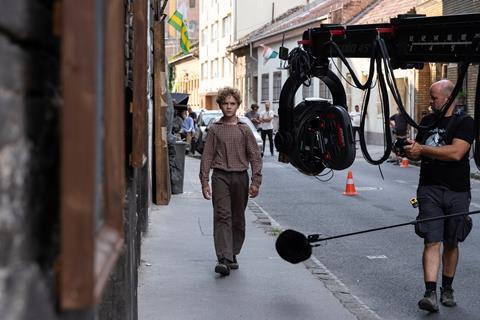
It was always going to be a challenge for Laszlo Nemes to find a 12-year-old Hungarian boy who could carry nearly every scene in his latest film Orphan, Hungary’s selection for the international feature Oscar. What made it even more complex and emotional was that the film is based on the traumatic true story of Nemes’ father, navigating a tough childhood in 1950s Budapest.
Nemes says the young actor “had to be a human being with some form of burden already. He couldn’t come out of a very protected childhood. We needed someone at that age who already knew much more about life than many adults do.”
Nemes adds with a laugh that he did not set out to find a boy with a physical resemblance to his father. “But by twist of fate, the boy who was the best by far for the role was the one who looks like my father at age 12.”
The team, led by casting director Eva Zabezsinszkij – who also cast Nemes’ Oscar-winning Son Of Saul (2015) and Sunset (2018) – scouted more than 4,000 boys before finding Bojtorjan Barabas. “Eva and I felt it immediately that he echoes something that was deeply moving,” recalls Nemes of the audition. “He was in a way lost himself, as my main character Andor is lost in his story. But he also had energy, or rage, that you need to put in a role like this.”
Orphan is set against the complicated politics of 1957 Budapest, when 12-year-old Jewish boy Andor, who has been raised by his stoic mother, learns the truth about the absent father he grew up idolising. Nemes co-wrote the script with his usual collaborator Clara Royer.
Barabas had never even acted in a school play, and was aged only 12 during the shoot. “But he understands everything happening in the script,” explains the director. “When we did our first read-through, he asked questions about his motivations, and he wanted to know everything. I’ve never seen an actor being so invested intellectually and emotionally in his role.
“This is a story that has been haunting me forever, since my childhood, when I discovered the big, big trauma in the life of my father,” continues Nemes. “Indirectly, this has impacted my whole life. So when I became a filmmaker, it was obvious I had to do something with this story, which is also an archetypal story, like Hamlet.”
Nemes fought for years – and waited out the pandemic – to make the film, which is a Hungary-France-Germany-UK co-production, led by Mike Goodridge of the UK’s Good Chaos and Ildiko Kemeny of Hungary’s Pioneer Pictures. He praises Zabezsinszkij for being a “great ally” throughout casting as well as the shoot, coaching both Barabas and Eliz Szabo, who plays Andor’s best friend Sari.
After biding his time to make Orphan, Nemes is picking up steam again – he is already at work on Moulin, shooting in Hungary and France, about French resistance hero Jean Moulin. He is also still planning the Cormac McCarthy adaptation Outer Dark, set up at Good Chaos with Jacob Elordi and Lily‑Rose Depp set to star.
The director remains in close contact with Barabas and is proud to know he is planning a creative career after his experience on Orphan. “He wants to be an actor, but he’s also contemplating film directing,” says Nemes. “I think he deserves to be seen and heard.” – Wendy Mitchell
Left-Handed Girl (Taiwan)
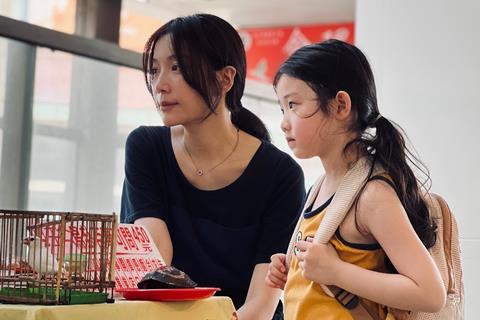
For Taiwanese American director Shih-Ching Tsou, working with child actors was the least of the challenges on Taiwan’s international feature Oscar contender Left-Handed Girl: one key scene also involves a meerkat. Five-year-old I-Jing is convinced by her grandfather that left-handed people are touched by the devil. This impression is reinforced when she uses that hand to throw a toy for the meerkat to chase, causing the creature to plunge from a balcony to its death.
“In the original, the meerkat was a monkey because I had a pet monkey when I was young,” says the writer/director, who was left-handed herself growing up (“I got corrected early on”) and acknowledges there are autobiographical elements in the story. Local laws prevented her from using a monkey, so she recruited a meerkat instead. The trick to keeping the animal happy and working was feeding it plentiful snacks, mainly cockroaches. However, different tactics were needed with her child star.
“I was determined to find this little girl with street casting in Taiwan,” says Tsou. “We tried. We did a social‑media casting. I watched between 50 and 70 tapes but couldn’t find her.”
Her eventual choice of lead, Nina Ye, was recommended by an agent. Only six years old at the time, she was already a veteran of commercials and more natural than the many non-professionals vying for the role.
Left-Handed Girl – picked up by Netflix for multiple territories after its Cannes Critics’ Week premiere – is Tsou’s solo feature-directing debut. She is best known for producing the films of Sean Baker, jointly directing 2004’s Take Out with the US filmmaker. On 2017’s The Florida Project, she and Baker worked with Brooklynn Prince, who played the loveable six-year-old protagonist running amok in a seedy Florida motel.
“They had a similar background,” says Tsou of the child actresses in the two films. Prince had appeared in Disney commercials and her mother was an acting coach.
“Nina was almost the same. She was in a lot of commercials and her mum had coached her for three years. She would prepare Nina every day, and help her memorise, so when Nina came to set, she was always perfectly ready.”
In the film, single mother Shu-fen (Janel Tsai) has returned to Taipei with her two daughters, I-Jing and sultry, rebellious teen I-Ann (Shih-Yuan Ma). They are making ends meet by running a noodle store in an open-air market, and also harbouring a big family secret that only comes to light in the final reel.
Left-Handed Girl – which boasts among its co-producers Mike Goodridge’s Good Chaos in the UK and Jean Labadie’s French outfit Le Pacte – was filmed neorealist style in a real Taipei market, and shot on a modest budget of just over $1m. Baker, who co-scripted, produced and edited, was preparing to make Anora when Left-Handed Girl went into production.
Tsou shot the film on her gilt-encrusted iPhone 13 – an upgrade from the iPhone 5 that Baker used on Tangerine, which Tsou produced. She describes herself as a “one-take director” and says she does not do rehearsals. She takes inspiration from Dogme 95 and the freewheeling, improvisatory style of filmmaking pioneered by Lars von Trier and Thomas Vinterberg in the 1990s.
Baker winning four Oscars with Anora “definitely helped us”, says Tsou – explaining it immediately meant people “paid attention” to Left-Handed Girl. Now Tsou wants to concentrate on more of her own projects.
“I want to tell my stories rather than produce someone else’s film, but I wouldn’t say never to working with Sean again. If the opportunity presents itself, why not?
“It’s fun to work on his films and I learned so much,” continues Tsou. “I did everything: street casting, location scouting, costume design, script supervisor, props… that’s how I got all the skills to apply on Left-Handed Girl.” – Geoffrey Macnab
The Love That Remains (Iceland)
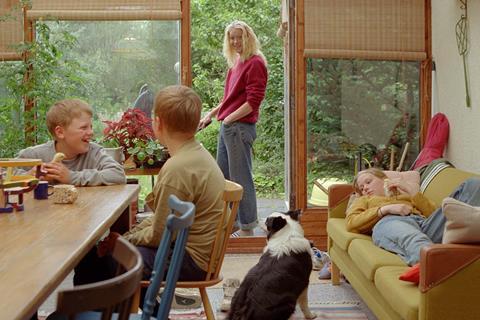
Filmmaking is a family affair for Icelandic writer and director Hlynur Palmason. His daughter Ida Mekkin Hlynsdottir turned 10 when she acted in his second feature A White, White Day (2019). She took on a more mature role in follow-up Godland (2022) and appears again – this time alongside her younger twin brothers Grimur and Þorgils Hlynsson – in The Love That Remains, Palmason’s fourth feature and Iceland’s submission for the international feature Oscar.
“I decided years ago that this period in my life – I see it as a chapter – is working from home and being close to my surroundings,” says the writer/director, explaining his return from Denmark, where he went to film school, to his home town Höfn i Hornafirdi. This rural community in east Iceland has been the backdrop to his last three features.
Palmason spent years observing his three children and the way they communicate with each other, as they made 2022 short Nest, shot over 18 months as they built a treehouse, and again in his latest short Joan Of Arc (2025), which filmed for two years.
There were two impulses that inspired the story of The Love That Remains, about how a family navigates life after the break-up of the parents (played by Saga Gardarsdottir and Sverrir Gudnason). Palmason had been thinking for years about the story of “a fractured family, or a family in the aftermath of a fracture”.
“Then in 2017, I filmed the roof being pulled off my studio [during demolition], which felt like an element in direct dialogue with this idea [of a family break-up].”
The footage opens The Love That Remains, an Iceland- Iceland-Denmark-Sweden-France co-production that launched in Cannes Premiere and is released in the US and UK respectively by Janus Films and Curzon.
“It’s always tricky to make a film about something that isn’t naturally dramatic, it’s more about how do you spend your time with the ones you love?” says Palmason. “I thought it was worth exploring. Small, mundane things can be fascinating. And the kids are just being the kids, but in this one they’re playing the kids of a different family.” (Palmason and his wife remain happily married.)
Every scene was carefully scripted – the kids are not improvising their lines – but the director enjoyed capturing their more unexpected reactions. “It’s stimulating for me as an artist to observe their way of communicating.”
Their mood can have “ups and downs”, says Palmason, especially the boys who were aged 11 for the main portion of the shoot. “If someone is annoyed, you can get something powerful out of that. You can try to capture that mood so it’s real.”
The filmmaker is not sure whether any of his offspring will pursue acting as a lifelong profession, “But they are all very creative people,” he says. Ida, now 17, is currently more focused on competitions with her Icelandic horses.
As a father, Palmason is aware of the magic he is collecting – his children are growing up in front of his camera, and will continue to do so over the next two years during the shoot of his ambitious feature On Land And Sea.
“It is the artist’s dilemma, just wanting to capture things,” he says. “The world is so full of images, of scenes to explore. It’s almost impossible to capture because they are so fleeting. Time is moving so fast.” – Wendy Mitchell



No comments yet