














Venice Film Festival’s industry event Venice Production Bridge (VPB, September 3-9) has expanded steadily since launching 15 years ago.
New for this year is VPB Location Market, a home for film commissions and studios to meet producers looking to shoot internationally. It joins a raft of VPB programmes that have been added over the years, catering to producer interests: from the idea and IP (Book Adaptation Rights Market) through to financial completion of projects (Venice Gap-Financing Market and Venice Immersive Market), works in progress (Final Cut in Venice) and sales and distribution (Market Screenings), as well as streaming (Meet the Streamers).
Meanwhile, this year’s VPB Focuses programme spotlights Greece and Switzerland, with additional projects, panels and participants from the two countries.
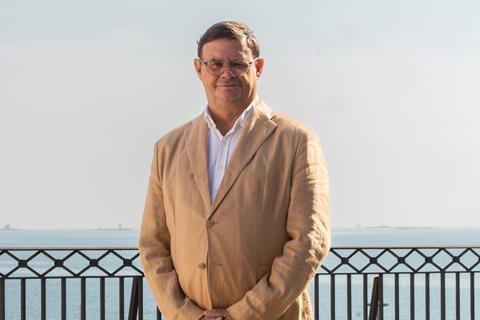
The new location market “completes the chain of services” offered to producers, says VPB head Pascal Diot, who has headed the event since its inception in 2012. It is starting small, with 10 commissions and facilities taking part, including Asturias Natural Paradise Film Commission in Spain and Uzbekistan National Film Commission. Diot hopes to grow that number to 30-40 next year.
Looking forward, he is considering a VPB programme centred on composers of music for films. “My aim is to provide producers with everything, to make the VPB a one-stop shop,” says Diot.
This focus squarely on production and producers means VPB is a very different event to sales and distribution markets such as Cannes’ Marché du Film or the Berlinale’s European Film Market.
The number of attendees has grown steadily over the years, from 400 at its first edition to around 4,000 last year; Diot expects the same number this year. Most events take place at the Lido’s Excelsior Hotel, meaning VPB does not have the space to expand. Aware of the constraint, Diot plays up the kind of attendee at VPB: “I’m not looking for quantity. I’m looking for quality. I prefer to have one decision-maker rather than four assistants.”
Different approach
Diot does not seem concerned about the high-profile launch of Toronto’s film market, which starts the day after VPB finishes. TIFF: The Market is helping to cover costs for 200 invited buyers, and is offering discounts on market screenings and official hotels for exhibitors. “It doesn’t have any impact on me,” says Diot, arguing that the Toronto market is a “waste of time, energy and money” for many of the European distributors who traditionally visit Venice and then San Sebastian to screen films.
But he adds diplomatically: “I wish [TIFF: The Market head] Charles Tremblay success, of course, because it would be good for the industry. But we’re not doing the same thing — he’s trying to have a kind of buy-and-sell market and to sell a lot of stands.” By contrast, VPB’s focus is to offer one-to-one meetings for producers.
The three-day Venice Gap-Financing Market will present 38 film projects in the final stages of development and funding, as well as immersive and Biennale College Cinema projects. They include new works from Jessica Hausner, Lav Diaz, Ursula Meier and Asmae El Moudir.
The Final Cut in Venice programme has selected six works-in-progress from Africa and the Middle East, including projects from Algeria’s Sofia Djama and UK-based Jordanian filmmaker Bassel Ghandour.
The Book Adaptation Rights Market, meanwhile, has 30 international publishing houses and literary agencies taking part in one-to-one meetings with producers that have an eye to striking deals for film adaptations. And the Meet the Streamers programme hosts meetings with seven platforms, including Netflix, HBO Max, Greece’s Cinobo and Switzerland’s SRG SSR.
A former sales and production executive at French companies including UGC and Canal+, Diot combines his role at VPB with heading up Tokyo Gap Financing Market, as well as being market co-ordinator for XR event UnitedXR Europe and working with Annecy’s MIFA animation market. The roles, he says, complement each other and allow him to build bridges between different disciplines and worlds for the benefit of each market.
Much of his work takes place on Crete, after moving from Paris two years ago. “I wanted to be between all the events on an island far from everywhere,” he says. “I have a good internet connection so I can work, and I benefit from the nature, sea and mountains all around me.”
The contrast between the hustle and bustle of a market like VPB could hardly be greater.





No comments yet