















US buyers and sellers are looking for the European Film Market to get the year off to the strongest possible start.
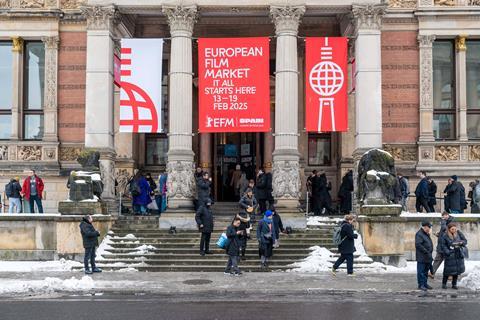
The US industry contingent is heading to Berlin in search of market dynamism after a mellow Sundance flattered by a rare bidding war that compounded the nostalgia around Park City’s last hurrah, before the festival relocates to Colorado in 2027.
A24’s $10m-plus US acquisition of The Invite, Olivia Wilde’s starry third directorial outing, was the standout onsite sale at Sundance. FilmNation jointly represented US rights with UTA Independent Film Group, and in Berlin will sell the remaining territories on the film starring Penelope Cruz, Edward Norton, Seth Rogen and Wilde after pre-selling most in Cannes last year.
Neon’s president of international Kristen Figeroid will kick off talks with European Film Market (EFM) buyers on Adrian Chiarella’s Sundance Midnight entry Leviticus after Neon acquired worldwide rights from WME Independent. Neon will distribute the Australian queer horror in the US later this year.
Leviticus marks the third year in a row Neon has followed this pattern after it snapped up worldwide rights at Sundance to Steven Soderbergh’s Presence and Michael Shanks’ Together in 2024 and 2025 respectively, before launching international sales in Berlin.
After the traditional slow start, US packages have begun to trickle in amid the customary 11th-hour avalanche of script-reading assignments that buyers love to hate. One standout title at time of writing was AGC Studios’ psychological thriller Sweat, a remake of Magnus von Horn’s Polish 2020 Cannes label selection that will star Ana de Armas. In the last few days packages have dropped from Lionsgate, Upgrade, WME Independent, and The Veterans, Manifest Pictures, and Concourse Media. Click here for latest titles.
After a somewhat subdued spread of European markets in 2025 that proved tough going for many, Berlin poses more familiar questions than answers. What exactly do audiences want? Can financiers prise talent away from high-paying streamer gigs? Are budgets coming down so the ask matches what buyers are prepared to pay? Will the streamers step up as reliable pay-1 buyers to help theatrical distributors mitigate investment risk?
Some of these conundrums can at least be framed within a fairly optimistic lens. Everybody is talking about the need to trim budgets, while great packages will always come along, and the pre-buy market rewards bold distributors who meet the moment. After all, it was back in AFM 2024 that Lionsgate president of international Helen Lee-Kim kicked off sales on a high-concept thriller adaptation directed by Paul Feig starring Sydney Sweeney and Amanda Seyfried. That was The Housemaid, which has grossed more than $354m at the global box office and $231m and counting from international markets.
New kids
Encouragingly, a host of new independent US distributors has excited the theatrical sector. These range from Toronto 2025 headline-grabber Row K to Black Bear to David Glasser’s 101 Studios — which has pacted with FilmNation as its international sales partner and wants to supply the market with a steady flow of commercial fare — to specialist operators such as 1-2 Special, Watermelon Pictures and Sumerian Pictures.
Last year, industry attendees were encouraged by Berlinale director Tricia Tuttle’s inaugural selection, and have been looking forward to this year’s follow-up edition, although they want to see more commercially viable titles. Tuttle has invited attendees to “warm themselves at the fireside of cinema” and noted many of the Competition films have rights available as she sought to galvanise business in the market.
The coming weeks and months will reveal who has an appetite for what. In addition to the independent start-ups, Warner Bros has launched a specialty division led by ex-Neon marketing guru Christian Parkes, and Paramount wants to expand global acquisitions under Lia Buman. Both moves came as a surprise in light of the ongoing battle around Warner Bros Discovery (WBD), whose board has agreed to an $82.7bn offer from Netflix to buy the streaming and studios business (which needs shareholder approval, likely in April), despite a hostile $108.4bn offer from Paramount that shows little sign of going away.
Consolidation always puts the industry on tenterhooks and the protracted WBD saga is no exception. Nobody knows how this will impact the independent space. Netflix is not the voracious festival and market buyer it once was, although it can never be counted out: the streamer that has been telling the world it now wants to move into theatrical distribution was one of the buyers in pursuit of The Invite at Sundance.
Opportunity knocks
AGC Studios chairman and CEO Stuart Ford acknowledges the challenges in the marketplace, but sees silver linings. “I believe all this consolidation and corporate volatility has created opportunity in terms of projects and talent for indies,” he says. “We’ve certainly pounced on a few things in the last few months, and I’m sure others have as well.
“The broader uncertainty does create opportunity in terms of access. I’m hoping we’re going to see some strong projects, which drive business. I’m also hoping these new US distributors will have bedded in and be active. That will inject some much-needed impetus.”
Ford, whose sales team will continue discussions in Berlin on Jeffrey Walker’s Sundance family world premiere Fing! starring Taika Waititi, has a packed production horizon. AGC is scheduled to start shooting Sweat at the end of March in Los Angeles and the UK (J Blakeson, whose credits include I Care A Lot and The Disappearance Of Alice Creed, directs), and is gearing up for Ellie Foumbi’s Fleur starring Halle Berry, and David Yates’ Phantom Son with Renée Zellweger.
Further signs of confidence were seen in the launch of Manifest Pictures, the Los Angeles-based sales company that has targeted “edgy genre fare to star-driven franchises” and is led by former Miramax head of sales Yvette Zhuang and former WME Independent co-head of international Zach Glueck. Backed by QC Entertainment and its principal financier Edward H Hamm Jr, the venture has also struck a strategic partnership with Gramercy Park Media to supply premium features at all stages of production and development for the sales slate.
Zhuang says the company’s backers and partners “saw the same opportunity that we did in the independent marketplace”. She adds: “You’re seeing consolidation and activity on the studio and streamer side that is going to create more room for the independents. We serve a more critical function now, with producers not being able to go to the studios and get that greenlight as quickly as they did five years ago.”
Manifest has locked in the Emma Roberts horror A Body In The Woods as its first sales title and will kick off talks and present itself to the industry. The partners are clear about building realistic budgets and bringing transparency to all their dealings.
“We don’t want to be dream-killers,” notes Glueck, “but we do want to be sober individuals in guiding our direct strategic relationships. We hope to develop a reputation with our third-party engagements for being honest and straightforward arbiters of the information that we have in the marketplace.”
Zhuang and Glueck are encouraged by the influx of new US buyers. “Spiritually, they’re in a similar place to us,” says Zhuang. “A lot of people are fearful in this market, but there are some of us who see the opportunity, and we are charging ahead.”
And while the Manifest co-founders hope the expanding ranks of US distributors translate into more films being made, they firmly believe international buyers can take the lead.
“You can still build based off international,” notes Zhuang. “That’s what the international indie space has been about when [US buyers] say they’ll wait and see, and international [marketplace] wants to get something made and there are producers and financiers out there that will take the gap against domestic.”
Astute independent buyers see the benefits of pre-buying in order to board a project at an early stage, rather than wait to see a completed film and risk losing out to a deep-pocketed streamer.
Bleecker Street has become considerably more active as a pre-buyer in the last few years. At AFM 2025 it picked up Buzzkill, Joe Lynch’s upcoming horror comedy starring Billy Magnussen and Lulu Wilson, and will be scouring EFM for more opportunities.
“We already have four to five films coming out in 2026 from pre-buys,” says VP of acquisitions and co-productions Miranda King. “We are increasingly leaning into the commercial space and are focused on comedies — we have the RuPaul action comedy Stop! That! Train! (May 29); we’re in post on the horror Victorian Psycho with Maika Monroe; and another horror, The Third Parent, later this year.” The 2026 pipeline includes Guy Nattiv’s female-led cult thriller Harmonia (working title), which is also in post.
The company just enjoyed its second-highest opening weekend ever and the first release through its event cinema label Croswalk, as K-Pop concert film Stray Kids: The DominATE Experience opened at number four at the North American box office over the weekend.
Bleecker Street has a fairly full slate and has seldom acquired Berlinale selections — Maria Schrader’s I’m Your Man in 2021 being an exception. “The market is definitely the more important aspect for Bleecker, and we’re very active in terms of conversations around scripts and packages,” says King. “The EFM is important to the ecosystem in terms of starting the year on the right foot.”





No comments yet