















Marty Supreme puts a driven, self-involved hustler at the heart of a sports drama. Writer/director Josh Safdie tells Screen why Timothée Chalamet was perfect to play an “outcast with dreams no-one believed in”.
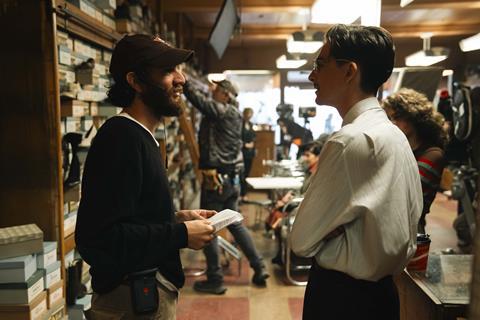
Josh Safdie had had enough of filmmaking. After the “10-year dream” of bringing 2019’s crime thriller Uncut Gems — directed with his younger brother Benny — to the screen, he was emotionally spent and ready to quit. “I told Ronnie [Bronstein], my co-writer, ‘I think I want to be an architect. I don’t know if I want to do this anymore,’” reflects Safdie on a recent trip to London. “I had a hollow feeling, where I looked around and I’d sacrificed so much life. It was a real agent of change for me. Ended up getting married almost immediately. Had a child quite quickly afterwards.”
What stopped the elder Safdie from pursuing a career in architecture was a combination of interests and people that, eventually, led him to co-write (with Bronstein) and direct Marty Supreme, the exhilarating tale of 1950s table tennis player and inveterate hustler Marty Mauser (Timothée Chalamet), who dreams of leaving his New York City Lower East Side Jewish neighbourhood and bringing ping pong to the masses, whatever the cost to those around him.
Safdie first met Chalamet at the New York premiere of the siblings’ 2017 thriller Good Time. “Before I even knew him as an actor,” he explains. “The person I met was fascinating. It was this energy charge. Timmy Supreme had this vision of himself but wasn’t where he wanted to be. He was against the wall. He was quite removed. He almost had this feeling of a misfit. I’ll never forget that feeling because you’ll never see it again.”
Not long after, he saw Chalamet in Call Me By Your Name. “He had this way of expanding the walls of that film. Timmy’s performance was this larger-than-life realism, this cosmic feeling of youth, but it wasn’t the guy I met. It was a different person. I watched him on stage at the New York Film Festival and he was so goofy. The energy was there. He couldn’t sit still. He fell off his chair, and everyone laughed. But we all laughed because we felt intimately tied to him. It was an incredible feeling, so I wanted to work with him.”
A year later, Sara Rossein, Safdie’s wife and an executive producer on Marty Supreme, picked up a second-hand copy of The Money Player, a memoir by 1950s table tennis champion Marty Reisman, thinking her husband would be interested. Safdie had been a keen player as a boy, competing against his uncle who frequented Herwald Lawrence’s legendary ping pong parlour in Times Square, and told stories of the people he played with. “They all were wiry, energetic guys. Outcasts with dreams no-one believed in,” says Safdie, who pictured Chalamet as one of them. “I sent him a video of a player playing, set to Peter Gabriel’s ‘I Have The Touch’. That was the energy I wanted. I said, ‘I want to do period, but with this timeless feeling.’”
History lesson
Chalamet signed on as star and producer. Rather than adapt Reisman’s life story, a fictional character inspired by the player allowed Safdie to incorporate “a lot of things that were interesting to me about New York in the mid-20th century”.
“There was a lot of historical footnotes I’d never thought of before,” he says. “I loved Japanese culture but never thought about what was going on after the war, outside of the broad strokes. I never thought about a sport I loved — table tennis — never thought about its history. That this parlour in Times Square was the first Black-owned business in the district. A story about a table tennis champion from Hungary being spared his life in the Holocaust because he was a champion. Fascinating stories that told a bigger picture. I’m not a historian, but they made me understand the world a little better.”
Still, Safdie’s heart was not quite in it. Then the pandemic hit and he began to address “this feeling of hollowness and chasing happiness”.
“Ronnie and I were working together every day. There was no vaccine. It was a scary time. We’d sit in our office — in the beginning sat 10 feet apart — talking about our lives and we would wonder why we were thinking about them in the context of these characters,” says Safdie who, with Bronstein, spent six years on the script. “It was a very interesting time for us as writers and informed the work in a dense way.”
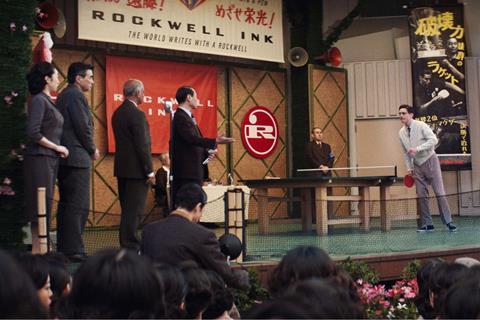
Meanwhile, Chalamet’s career went stratospheric — but the actor remained committed, installing a ping pong table in his New York apartment, and continuing to brush up on his skills even as he made two Dune films, Wonka, The French Dispatch and A Complete Unknown. “He knew how to play every point,” says Safdie. “Not only is he training to play, he has to learn [his moves] like a dance routine. He’s like [ballet dancer Mikhail] Baryshnikov.”
A24, which distributed Good Time and Uncut Gems, had been tracking the project for some time. “I was constantly sharing this idea with them,” says Safdie. “And it was a big movie. It’s period. It’s international. The costumes, you can’t just go to thrift stores and buy them. I wanted lots of extras. I needed to recreate reality. I wanted [production designer] Jack Fisk. In the beginning he wasn’t available; he was doing Killers Of The Flower Moon. And I knew I wanted [cinematographer] Darius [Khondji, who shot Uncut Gems]. So it was going to be a big film, and I didn’t know if A24 was willing to go there. When we finished the script, I brought it to them first and they believed immediately.”
Given the budget was the highest in the company’s history, at a reported $70m, Safdie says A24 did not ask him to soften or make more sympathetic the self-involved Marty — whose need for funds to participate in a climactic championship drives the narrative and unleashes scatter-shot impacts.
“They knew Marty was a romantic and Noah Sacco [head of film] at A24, he was aware of the love that Marty can elicit, because love is a great agent of charm and you do feel those moments where you can love him,” explains Safdie. “You can feel those moments of pure joy, his desire to connect with somebody. They knew those moments were going to be very powerful because they knew how I was going to capture it.
“They knew I’m a romantic and they knew how I was going to direct it. That’s an example of a studio knowing how I’m going to shoot something, knowing those moments are going to be powerful and will help keep an audience grounded. They also knew the nature of sport is that you’re rooting for somebody.”
It helped, too, that Chalamet was playing Marty. “This young man and his youth were going to be very important, too,” continues Safdie. “You have very little knowledge of consequence when you’re young, because the world is so big and there are so many opportunities. I think youth is quite romantic and him chasing love, adoration is also a great grounding agent. They never were worried about it, and never asked me to dull the edges because they knew that was going to be an interesting thing for audiences. I don’t believe in anti-heroes. That’s the only way you can write a character like that.”
Face value
Safdie worked with longtime casting director Jennifer Venditti to people the film with an eclectic mix of professional and non-professionals — Gwyneth Paltrow, Odessa A’zion, Tyler Okonma (aka Tyler, the Creator), Fran Drescher, Kevin O’Leary (TV’s Shark Tank), fashion designer Isaac Mizrahi and filmmaker Abel Ferrara among them.
“I’ve seen period films where one face, one extra takes me out of the whole film,” explains Safdie. “Because I was going to be doing something anachronistic with the music, everything had to be perfect. I said to her, ‘Let’s pull out all the people who never made the previous films, all the timeless faces. Think about them for smaller roles, and if we don’t find roles, let’s put them as extras.’ So she was very involved in the extras casting as well.”
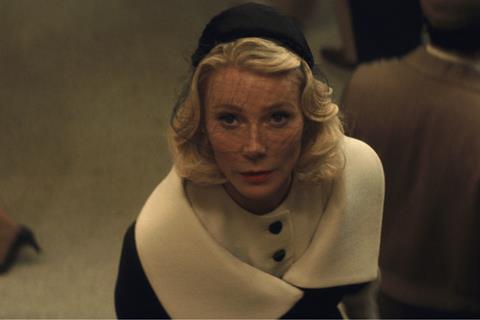
The approach to casting was the same for the 150-plus speaking parts. “They can be an actor, they can be a personality, they can be a first-timer, they can be a doorman. You want to bring the history of that person’s life to the role. Oftentimes with known people, it’s helpful because with a Gwyneth you’re bringing her whole career. You’re bringing The Talented Mr Ripley, you’re bringing Great Expectations, you’re bringing Seven.”
Paltrow plays Kay Stone, a former movie star in a loveless marriage who falls for Marty, in what was her first screen role in several years. Safdie initially approached her in 2021 but was told she was not taking meetings. He tried again two years later and was able to get a sit-down because her brother Jake is a filmmaker and a fan. “She didn’t really know my work. I went in there and I had a character, I had a biography, I had a photograph. And my passion for it, my exuberance, was very inspiring to her,” says Safdie.
“They do this thing in Hollywood, where they have someone come in after 15 minutes and say, ‘Your three o’clock is here, do you want to push it?’ Having been turned down so many times in Hollywood, I knew how it worked. She pushed four times. I think she liked that she was able to play someone returning to acting. She was able to embrace the meta quality.
“She turned to me before we started shooting and said, ‘I hope I remember how to do this.’ It was so touching because here’s this woman I’ve looked up to since I was 13 years old, and here she was completely humble.”
From the first video Safdie sent to Chalamet, he had envisioned using 1980s music — Peter Gabriel, Tears For Fears, Public Image Ltd — to help score the film. “In the ’80s, Reagan was chasing the prosperity and opulence of the ’50s, the glory time, the American dream. So there was a fascination in revisiting the America of the ’50s through the lens of the ’80s,” he says. “And, on a basic level, I believe the movie’s being told from the ’80s. Marty is looking back at his past. He has a granddaughter. He’s at a Tears For Fears concert, listening to ‘Everybody Wants To Rule The World’.”
Marty Supreme, which A24 released in the US on Christmas Day and Entertainment Film in the UK on December 26, marks the first time Safdie has directed without Benny since his 2008 debut The Pleasure Of Being Robbed (his sibling opted to helm The Smashing Machine).
“Of course it was emotionally different,” reflects Josh. “Dwayne [Johnson] had brought that film and Mark Kerr’s life to us, and Benny was very interested in that. I wanted to investigate life through this character and this world. And table tennis was important to me, [it] wasn’t important to my brother. I love his movie. I learned a lot about him watching his film. And I think he did with me, with Marty.”






No comments yet