

















What are the prospects for the 2026 edition of the Berlinale and its market in the second year under new leadership? European film buyers and sellers share their thoughts with Screen.
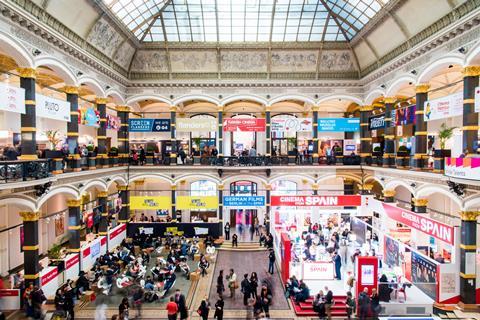
“We are so confident in the charms of these 22 films that we say defiantly, ‘If you don’t find something here to love, you don’t love cinema’,” said festival director Tricia Tuttle when announcing the Berlinale’s 2026 Competition line-up. Now in her second year, Tuttle and her team have begun to stamp their mark on the festival and its industry offer, the European Film Market (EFM). Across the board, the industry speaks highly of Tuttle and her team.
“The whole atmosphere is completely different,” says Tobias Lehmann, managing director of German distributor Alamode Film. “She’s reaching out to all the producers, reaching out to us as a distributor, which nobody before had ever done, and there’s a good relationship. I also like their process for how they choose their films. It’s transparent — they never talk badly about films.”
Jan Naszewski, founder of New Europe Film Sales, adds: “She has hired smart people and I like her programming team. She’s forward-thinking, very aware of today’s cinema and the challenges it faces.”
New Europe has Dara Van Dusen’s A Prayer For The Dying starring Johnny Flynn and John C Reilly playing in the Perspectives section for debut filmmakers. “They made a strong case for it,” says Naszewski, whose company shares sales rights on the film with Anton. “We had invites from other festivals but we chose to wait for Berlin. We felt like it still means something to be a Berlinale director.”
Jean-Christophe Simon, CEO of Films Boutique, reckons the programming team has been more aggressive in going after the films they wanted in their second year. Not only were they more aware of what was coming up and when, but conversations were started earlier too.
“You could feel they were positively looking for films and trying to secure the best selection possible,” says Simon, whose line-up includes two Berlinale films: Mahamat-Saleh Haroun’s Competition title Soumsoum, The Night Of The Stars and Kilian Armando Friedrich’s Panorama feature I Understand Your Displeasure.
There is also a real sense that the industry looks forward to meeting at EFM, the first major market of the year, which acts as an unofficial kick-off event for many sales agents and distributors (although many will have already travelled to Paris’s Rendez-vous, Rotterdam’s CineMart and/or Göteborg Film Festival). “We need a strong EFM, and we need a strong Berlinale as well — it’s very important for us, and it’s always exciting to see their selection,” says Anne-Cécile Rolland, head of acquisitions at France’s Pyramide Distribution, which acquired rights to last year’s Golden Bear winner, Dag Johan Haugerud’s Dreams (Sex Love).
“I am positive going in and hope to be surprised,” says Huub Roelvink, founder of Benelux outfit Cherry Pickers Film Distribution, who notes that hit movies such as Ilker Catak’s 2024 Oscar nominee The Teachers’ Lounge premiered in the Panorama sidebar in 2023. “You never know if you are going to bump into something like that.” Casting his eye across the main Competition, he says, “It has a nice balance. It is a proper worldwide selection with some interesting-looking US, UK and European films.”
Titles that have garnered attention since the line-up was announced include Kornel Mundruczo’s At The Sea starring Amy Adams, Markus Schleinzer’s period drama Rose with Sandra Hüller, and Australian filmmaker Warwick Thornton’s Wolfram. Catak also returns to Berlin with Turkey-set drama Yellow Letters, his first feature since The Teachers’ Lounge.
Elsewhere, vampire movie The Blood Countess starring Isabelle Huppert plays in Berlinale Special, as does Padraic McKinley’s The Weight starring Ethan Hawke and Russell Crowe, which has its international premiere after a strong reception at Sundance. Aidan Zamiri’s The Moment featuring music superstar Charli xcx is in Panorama.
Among many within the industry, however, there are still question marks about the 2026 Berlinale. The emerging consensus is that the programme appears diverse, intellectually ambitious and cinephile-friendly, with a mix of established and new filmmakers. But once again, many express concern that the line-up is lacking strong commercial offerings and enough glitzy, star-laden pictures that can attract significant audiences at cinemas.
At a time of persistent talk that Berlin has fallen behind Cannes and Venice in recent years, some are worried that more was needed to close the gap. “The line-up is not a step ahead compared to last year,” says Lehmann. “There are some interesting authors in the Competition like Emin Alper, Angela Schanelec and Karim Aïnouz. But from a distributor’s perspective, they are not very commercial. There might be some surprises but on paper, the Competition looks very thin.”
Power players
Many acknowledge that the Berlin team are programming with one hand behind their back, challenged by the festival’s position in the calendar. Its February dates, which tend to fall a month before the Academy Awards, mean it is of little use for pushing films into the all-important awards season corridor.
Far tougher, though, is competition with Cannes, which has established itself in recent years as the pre-eminent festival launchpad for commercial arthouse titles. Cannes last year premiered a slew of films that went on to be box-office hits and Oscar contenders, including Sentimental Value, Sirât, The Secret Agent and It Was Just An Accident. In total, six films from Cannes 2025 scored 19 Oscar nominations this year. It also drew major stars, hosting the likes of Tom Cruise for Mission: Impossible — The Final Reckoning.
For sales agents, Cannes in May is the place they want to launch their films, and many will hold back titles to try to secure a berth in the French festival’s official selection. Making it tougher for Berlin, Cannes can afford to be picky and will often decide very late on its selection.
If that fails, they can submit again to Venice in late August, giving a second chance to hit the awards season corridor. Four films that launched at Venice last year — Frankenstein, Bugonia, The Smashing Machine and The Voice Of Hind Rajab — picked up 15 Oscar nominations across the board. By comparison, Berlin launched one of this year’s significant Oscar contenders, Richard Linklater’s Blue Moon starring Ethan Hawke, which earned original screenplay and best actor nominations.
Several industry executives tell Screen International that leading producers and sales agents have held talks about “investing in Berlin to make it stronger,” and making sure some of their best films are submitted to the festival. “The reality is that if you have Cannes or nothing, it is not very healthy for the market,” observes one.
“I would love to have more examples of Berlin movies that work for the market beyond the likes of The Teachers’ Lounge and A Separation [the latter won the best foreign-language film Oscar in 2012 after winning the Berlinale’s Golden Bear],” says another.
For all the discussion though, the business reality remains that it often pays to secure a berth at Cannes. As Cherry Pickers’ Roelvink expands: “One sales agent told me something that I never realised. When they have a film in Cannes, they get double the MG [minimum guarantee] that they would in any other festival. She said this is not an exaggeration.
“It surprised me but actually, I could confirm this by the prices I paid last year — I needed to pay that price if I wanted the films. So in that sense, Berlin is in a tough spot.”
Slow ahead
For some, this year’s EFM is likely to be marked by caution rather than aggressive buying. “Given the projects that have been sent round so far, I think it is going to be rather slow,” says Lehmann. “Also, everyone is feeling a little bit scared and unstable in the film business — there is not so much risk-taking.”
Alamode already has German rights to three Berlin films: two Competition titles in Catak’sYellow Letters and Hanna Bergholm’s Nightborn, and Adrian Goiginger’s Panorama film Four Minus Three. “So we don’t have a big urge to buy something,” he says. “We are being very selective.”

Others will be in a buying mood. “We always try to buy one or two titles, but we don’t come with a number in our head,” says Rolland, who says she and her team will be paying attention not only to the films in official selection but also to the EFM’s Co-Production Market. Of note this year, she adds, is a special EFM showcase on animation in partnership with Annecy International Animation Film Festival.
Indeed, many buyers use Berlin as a pre-buy market for titles that they hope will premiere at Cannes or Venice, notes Naszewski. Simon accepts that the film sales market is cautious, but remains optimistic for business at EFM. “A lot of distribution companies are going to be there,” he says. “You still have people going to the theatre to see outstanding films. Everybody is still looking for outstanding products or for commercial films.”
Simon cites the box-office success of Oliver Laxe’s Sirât, which attracted 710,000 admissions in France in 2025 through Pyramide, or the fact that five festival films are shortlisted for the international feature category of this year’s Oscars.
“People still want to see the exceptional,” says Simon. “That’s what makes this business and this industry exciting. You might assume that a film looks small, but it could be one that makes the Oscar shortlist.”






No comments yet