














10Dance producer Takako Miyauchi was adamant that the UK-set dance scenes in Netflix’s live-action adaptation of Satoh Inoue’s popular BL manga shoot on location. “When filming something emotional we must fully consider how the environment affects the actors’ energy and performance,” Miyauchi of production company Episcope said. “The meaning and impact of ’standing in that actual place’ is significant.”
Directed by Rurouni Kenshin’s Keishi Otomo, production on the gay love story marked a large-scale collaboration between Tokyo and the UK. Filming took place at the Tower Ballroom in Blackpool in the northwest of England for six of the production’s 46 days, with the help of nascent UK-based production service company Tetra.
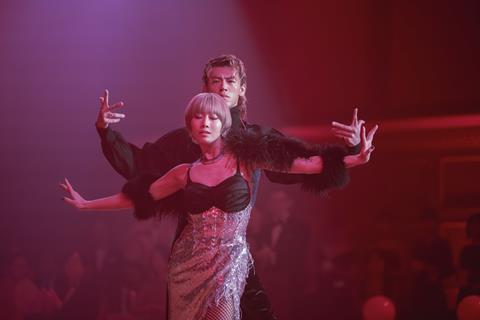
10Dance, which stars Ryoma Takeuchi and Keita Machida as rivals-turned-lovers Shinya Suzuki and Shinya Sugiki, required a massive cross-border logistical effort, including a travelling crew of nearly 50 members.
Netflix executive producer Yoshihiro Sato said, “The project actually began with a sense of despair. Before the film was greenlit, we went to see a professional competition and were stunned by the dancers’ level. It felt impossible to expect actors to reach that standard. Using VFX was an option, but it would have required an enormous number of shots and made it difficult to estimate the budget.”
In the end, extensive preparation allowed the 10Dance team to capture real dancing, on location.
How did the decision to film in the UK impact the storytelling creatively and logistically?
Takako Miyauchi: It was an extremely significant decision. I believed that taking the actors to the sacred ground of ballroom dancing and letting them dance there was essential to achieving the richness and strength this film needed. It was also important to let the audience truly feel the roots of the protagonist, Shinya Sugiki.
The limited schedule made the shoot extremely challenging, and I know it put a great burden on the crew. But I’m convinced the decision was the right one – anyone who sees the Blackpool footage will understand. It undeniably elevated the intensity of the actors’ performances. The UK crew members were all excellent, and I’m grateful to the line producer who assembled such a strong team.
What was the biggest difference you found between the working style in the UK vs. Japan?
Since this was my very first overseas shoot, I started with very little prior knowledge and everything felt like a continuous process of learning and adjusting to cultural differences. I still can’t always tell what is specifically “British” and what is simply standard practice in Western productions, but with that said, the role of the assistant director [AD] is completely different.
In Japan, ADs are deeply involved in both the creative content and the progress of preparation, essentially running the show. That means the director’s workload is also significantly different. I’m genuinely interested in learning more about how UK productions are prepared, because I felt there may be hints there for solving some of the challenges faced by the Japanese film industry.
Staff are hired on a weekly basis. I was surprised that negotiations couldn’t be made on a “per month” basis. There is a logic to it. If you have a large enough talent pool, it seems like a very functional system.
What was the biggest difference in the creative process between UK and Japan?
One thing that struck me was how each department communicated directly with the director and made decisions together. In Japan, assistant directors or the production department almost always stand between the director and every prep department. There are pros and cons to both systems, but I often found the UK approach refreshing.
Did the language differences create any unexpected challenges?
The advance ordering of camera, sound, and special equipment was challenging due to differences in terminology and work culture. I also worried a lot about possible omissions once we arrived on location. Since the shooting location was far from London, recovering from any oversight would have been difficult. While not strictly a language issue, communication with the local lab was also challenging. That is something I see as a task to improve going forward.
What was a challenge you faced due to filming on location in the UK?
I believe the UK staff did not anticipate that we would still be unable to finalise the location for our last shooting day in the UK even after arriving there. The Japanese producers broadened the scope of the location search until the very last moment, and the UK staff made every possible effort to accommodate that.
What authenticity did filming on location offer, compared to filming as a virtual production in Japan, or doubling another location?
When filming something emotional – especially dance – we must fully consider how the environment affects the actors’ energy and performance. The meaning and impact of “standing in that actual place” is significant.
What would you do differently next time if you were to film another Japanese production in the UK?
To ensure the director and the local crew could communicate directly and closely, we prepared the workflow so that someone who could sit at the very centre of both the language and the roles was always present.




No comments yet