










Dead Man’s Wire depicts a real-life hostage-situation that played out across the media in 1977. Tim Grierson talks to director Gus Van Sant and screenwriter Austin Kolodney about bringing the dramatic events to life.
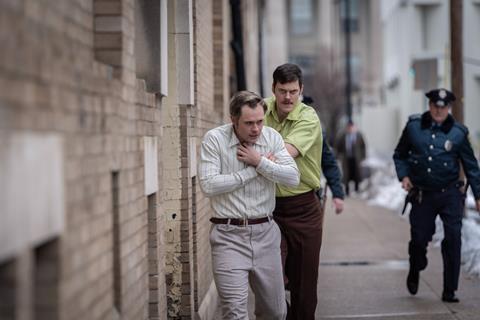
Austin Kolodney in no way condones the actions of Tony Kiritsis, a struggling, socially awkward Indianapolis businessman who, in 1977, kidnapped mortgage broker Richard Hall at gunpoint, accusing the lender of sabotaging his chance at the American Dream. But when the screenwriter heard about Kiritsis’s story during the Covid lockdown, he admits he could relate to the man’s populist outrage.
“It struck a chord with me,” says Kolodney. “I was dwindling my bank account and not finding work and feeling frustrated, seeing certain larger corporations do just fine during a global pandemic and bailing themselves out. I was upset – maybe not as angry as Tony, but I was angry. I think we all have those moments where we’re frustrated at what feels like an opaque apparatus – the 1% who are able to keep the rules in their favour and stack the deck.”
Kolodney began researching the incident, fascinated by Kiritsis’s attempt to make his demands heard by tying Hall’s neck with a wire that was attached to a shotgun. He started writing on spec a stripped-down thriller about class resentment, after reaching out to Alan Berry and Mark Enochs, the filmmakers behind 2018 documentary Dead Man’s Line, about the bizarre kidnapping.
The resulting feature film Dead Man’s Wire, starring Bill Skarsgard as Kiritsis and Stranger Things’ Dacre Montgomery as Hall, could not be timelier, but the relatively unknown screenwriter had to be patient before the project finally got off the ground.
“My manager sent the script out to 150, 200 places,” recalls Kolodney. “Studios, financiers, production companies. There was a lot of radio silence. Every once in a while, I did hear, ‘I don’t see it as a movie. It’s so regionally specific – it’s not going to play to a wider global audience.’” But Kolodney, who cut his teeth making comedies for Funny Or Die and Comedy Central, held out hope the script would eventually reach one director in particular: Gus Van Sant.
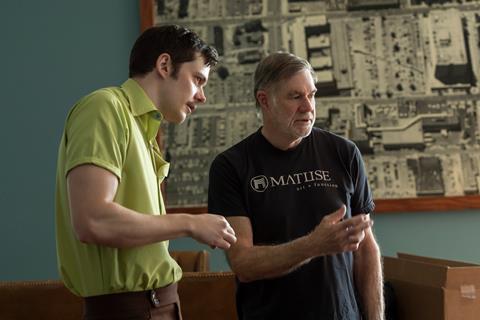
It so transpired that Van Sant said yes… although this was only after a previously attached director had exited the project.
“A lot of the characters in my films are on the verge of being criminals or getting into some kind of trouble,” explains Van Sant, whose decades-spanning resumé includes lawbreaker tales Drugstore Cowboy and To Die For. What attracts him to these stories? “Somebody’s trying to get away with something. It has that suspense and that conflict within it,” he replies.
Fast turnaround
Dead Man’s Wire – which premiered out of competition at Venice – had a tight pre-production schedule. Van Sant received the script in early September 2024. Filming commenced in Louisville, Kentucky, around late December, with the director having only 19 days to complete principal photography.
Van Sant – who earned Oscar nominations for Good Will Hunting and Milk, and won the Palme d’Or for high school-shooting drama Elephant – found the speedy process for Dead Man’s Wire reminiscent of his earliest days as a scrappy independent in the early 1980s. “My first film, Mala Noche, I did in about 19 days as well,” he says. “But that was operating with a crew of three people and a cast of two. We could fit in a car. We location-scouted in the morning just by having coffee and saying, ‘Who knows somebody that has a restaurant?’ That’s one way of doing it.”
But the fast turnaround was not the only way he reconnected with his past. “For Mala Noche, my DoP was a news cameraman – I met him at the lab we used.” Van Sant instructed Dead Man’s Wire cinematographer Arnaud Potier (Guy Nattiv’s Skin) to think like a news cameraman, helping to bring a further sense of authenticity to the story. “I just told him to go in and grab all the stuff that he thinks he wanted.”
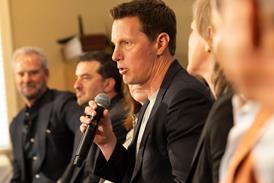
The production occasionally incorporated Ikegami broadcast TV cameras from the era, and Van Sant tasked production assistants with shooting their own 8mm footage as well. But while Dead Man’s Wire took pains to recreate the crime’s most outlandish moments – in particular, an unorthodox press conference Kiritsis orchestrated during the tense standoff – Kolodney heeded the advice of another director who, for a while, had been attached to the project: Werner Herzog.
When Kolodney first met with the eccentric German filmmaker at his Brentwood home, “I knocked on the door, he answered and said, ‘Austin, I’m going to wean you off the facts and bring you closer to the truth.’ That was like a bullet to the chest. He’s a poet, that one simple line.”
After Herzog exited the film and Van Sant came on board, Kolodney shared the comment with the incoming filmmaker. Eventually, Dead Man’s Wire did somewhat veer from the historical record, including the fact Skarsgard and Montgomery are about a decade younger than their real-life counterparts.
“The way that you would typically do [casting] is that Tony was 45, [and there are] 45-ish actors that you choose from,” says Van Sant. “But I was afraid of repeating myself by casting the movie stars that could find you funding.” He talked to Dead Man’s Wire producer Cassian Elwes, with whom he made the minimalist drama Gerry, about his decision to go with Skarsgard and Montgomery.
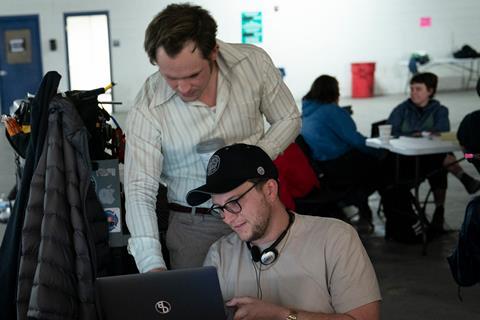
“There were people that you could cast that would make it easier – [the producers] had the financing, but they hadn’t sold it to a distributor,” recalls Van Sant. “That wasn’t my worry, but I said to Cassian, ‘How about these two guys?’ And he’s like, ‘Well, they’re not exactly…,’ but then he just settled with the idea.”
Haves and have-nots
Opening on January 9 in the US via Row K Entertainment (Vertigo’s UK release in March is too late for this year’s Bafta Film Awards), Dead Man’s Wire has received praise for its non-sensational look at a forgotten US crime that underscores the country’s never-ending clash between the haves and have-nots.
It has also been hailed as a comeback for Van Sant, whose last big-screen project was Don’t Worry, He Won’t Get Far On Foot, which debuted at Sundance in 2018. Not that the filmmaker has been inactive between features, with the pandemic also to navigate.
“Covid made you stay at home,” says Van Sant. “But after a year of that, I was invited to shoot a Gucci commercial in Rome. So, I was shooting; it just wasn’t a film that ended up in a theatre. Then after that, I did six episodes of Ryan Murphy’s [Feud: Capote Vs. The Swans]. I was doing all these things as film projects.”
Dead Man’s Wire viewers tend to fall into two camps. Some root for the aggrieved everyman Kiritsis, while others sympathise with Hall, who endured a harrowing ordeal despite not being directly involved in the mortgage firm’s loan practices.
Kolodney’s own take became increasingly nuanced during his research process, having initially sympathised with Kiritsis’s financial dilemma. So he is not surprised by filmgoers’ varied reactions – and he heard similar debates during production.
“Our script supervisor identified more with Richard and did not like Tony that much,” recalls Kolodney. “Then our best boy electric did not like Richard or the mortgage banks, and thought Tony was a capital-H hero. I hear both sides – what I wanted was this dialogue.”






No comments yet