




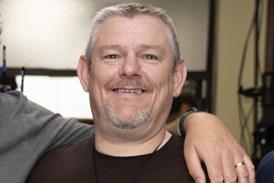

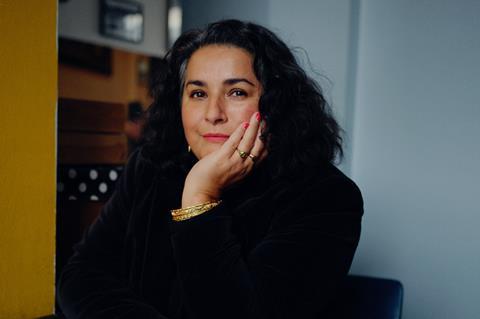
Nearly three decades into a career that began with a casting assistant credit on James Bond film Tomorrow Never Dies, UK casting director Shaheen Baig is seeing her career reach a new peak.
In September, her casting work on Netflix miniseries Adolescence earned her a first Primetime Emmy. In October, casting resource company Spotlight presented her with a special discovery award (“for unwavering commitment to new talent”).
Earlier the same month, Baig attended the BFI London Film Festival for the UK premieres of her latest casting work: feature films Anemone, Rose Of Nevada, H Is For Hawk, My Father’s Shadow and The Thing With Feathers, and TV miniseries The Death Of Bunny Munro. This crop of titles followed hot on the heels of the UK release for an earlier quartet of films – Harvest, Hot Milk, Urchin and Brides – with the casting director earning her 13th and 14th nominations at the British Independent Film Awards for the latter two titles.
“That just makes me look like Mr Greedy,” says an embarrassed Baig when the list of her 2025 titles is reeled off to her. “That is actually several years of work. The film festival this year was special because it’s very rare you have that many projects. They’re all completely different to each other and they’re all brilliant experiences.”
Baig’s status as the casting queen of UK independent film has been a slow build, beginning in the late 1990s supporting a trio of casting directors – Debbie McWilliams, Jina Jay and Patsy Pollock – and earning an early reputation for exhaustive searches for child actors, including on Billy Elliot, Love Actually and PJ Hogan’s Peter Pan.
Wary of typecasting (“casting directors get pigeonholed in the same way actors do”), Baig went on to mix it up with the likes of Black Mirror, Peaky Blinders, Giri/Haji and The Third Day on TV, and God’s Own Country, The Falling and The Impossible on film – the latter trio of titles offering discovery roles for Josh O’Connor, Florence Pugh and Tom Holland.
She cast Harris Dickinson in a small role that was cut out of The Falling and as the male lead in Charlotte Regan’s Scrapper – and the actor returned the favour by asking her to cast his debut feature Urchin. “I have done quite a lot of projects where actors have made that transition into directing,” says Baig, referencing Reggie Yates (Pirates), Nathaniel Martello-White (The Strays) and Samantha Morton (The Unloved).
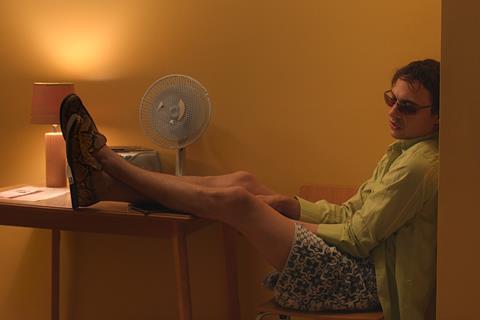
Urchin involved a long search to find the actor to play its protagonist – a homeless addict given a shot at redemption after release from prison. “We tried lots of different versions of Mike,” says Baig. “We saw lots of brilliant people, and we tried many different things.” Helpful to the process: “We weren’t under pressure to have a big star. Of course, any sales agent, any financier, would love profile, but it was so important to get that role right.”
The solution finally arrived in the shape of Frank Dillane, best known for TV work including Fear The Walking Dead. “Frank is an actor I’ve been championing for years,” says Baig. “I just knew that he was worthy of a lead role in a film.
“He came in, did a great audition, and that was a real moment of seeing that Harris could see in Frank what I saw in Frank, and had seen in Frank for years. There’s something so exciting when an actor is given an opportunity that they deserve, and they really run with it.”
Baig, who grew up in Birmingham in a mixed-heritage family (her father is from Pakistan), is an advocate of both regional casting and community outreach – an approach she was able to put into practice with Clio Barnard’s upcoming feature I See Buildings Fall Like Lightning, set in Birmingham’s Shard End, and current casting assignment 7 Miles Out for Carol Morley, set in Stockport, near Manchester.
For the latter, “Our cast will end up being a real mixture of professional actors from Greater Manchester and a lot of people from that local community”, she says. “That’s a wonderful thing, especially when you’re making an independent film on a shoestring, and you’re relying heavily on a community. They feel like they’re part of the project. It’s a way to make a production feel like it’s properly embedded in a place.”
Foremost among the changes Baig has witnessed during her professional lifetime would be the greater “pressure on casting directors to be like an additional producer, because so much weight, especially in film, is in attaching the actor that triggers the finance.
“The casting director is nine times out of 10 the first HOD that comes on board,” she adds. “You’re constantly pivoting, trying to find the combination of actors or the one actor that is going to greenlight the project.
“Sometimes I can be consulting on a project for years before it gets the actors that can get it up and running, but you have to stick with them. I work on a film because I want people to go and see it, and ideally in a cinema. I’m going to do the very best I can to get the cast that can help facilitate that.”
Broadening access
More positively, access to the casting industry has broadened, and that is thanks partly to the casting course offered by the UK’s National Film and Television School (NFTS), which was advocated by Baig and Jay, and in which they remain involved. “Casting has always been quite a closed shop,” says Baig. “It’s been a hidden craft in a way – nobody talked about casting because it’s a confidential aspect of the industry.”
The NFTS supported Baig and Jay’s vision for the course. “It was important to us that we had students from all over the country, that we had more than 50% on bursary, so we got financial support,” she says. “The course is purposely part-time and a mix of Zoom and in-person – it’s in the evening, so people who have families, who have jobs, can still do it. We’re now on our sixth cohort, and we have more than 70% in work.”
Shaheen Baig Casting has two of the course graduates employed in its own six-person team. Baig is also a trustee of Open Door, a non-profit organisation that helps people from low-income backgrounds access drama schools, offering acting training, audition tutoring, travel expenses for auditions, pastoral support and mentoring. “Drama school can feel exclusive,” she explains. “It can feel unaffordable. They often feel like privileged places that you can’t see yourself in.”
The upside for the UK film and television industries will be a broader pool of talent to populate roles – the kind of talent the likes of Adolescence producers Warp Films, Matriarch Productions and It’s All Made Up Productions have been championing.
“Winning the Emmy for Adolescence was completely nuts and fantastic,” says Baig. “I couldn’t have been happier to be in the company of the people that made that show, because it’s some of the best people in our industry. Warp Films has been supporting me since early in my career. We’ve come a long way together, and I feel so proud of them, but also held by them.”
After winning the Emmy, Baig found herself talking to mainstream media. “The positive experience of all the attention is people were talking about the art of casting, and what does it mean to cast somebody like Owen Cooper. That was a joy for me, because someone’s going to read one of these articles and maybe go, ‘I’d quite like to do that job, that sounds interesting.’ I’ve come away from the experience thinking, ‘Okay, now we’re starting to talk about what it is to put a cast together.’”





No comments yet