














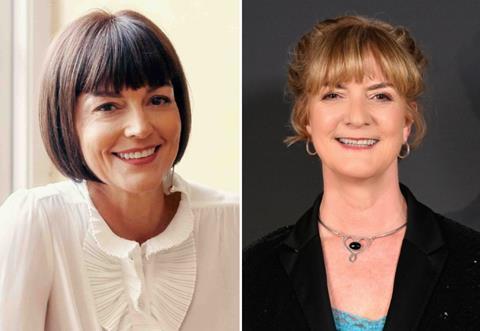
Bafta CEO Jane Millichip and Bafta chair Sara Putt are satisfied with the impact of voting interventions in key film categories and will always consider further tweaks, they said today, following the nominations for the Bafta Film Awards.
The best director category produced a nearly identical list to the one chosen by US Academy voters last week. For Bafta, a jury creates a 10-film longlist of gender parity, guaranteeing the six nominees will include at least one woman. This year, it was Chloe Zhao for Hamnet. (Last year it was Coralie Fargeat for The Substance.)
Millichip and Putt confirmed Bafta would be keeping the intervention as they were happy with the way it was working.
“We’re committed to it,” said Millichip. “The reason we have put that intervention in is to encourage our voting members to kind of consider [the longlisted films]. We are not in the business of telling people how to vote. It is our job to alert our members to watch the widest selection of movies they can, hence the randomised viewing groups and the longlist, and to encourage them to watch outside of their preference sphere as well.
“With the number of films [directed by women] rising as a proportion of the total entered, that kind of suggests that might be working. It’s not [an] empirical fact, but we will continue with that intervention as long as we feel that women’s films are not being seen enough and not considered enough.”
She pointed out that 25% of the nominated feature films across all of the categories are directed by women, which Bafta said was roughly the same percentage as last year. Furthermore, the 11 nominations for Zhao’s Hamnet is the highest number of nominations for a film by a woman in Bafta’s history. The second highest is Jane Campion’s The Piano (10), followed by Kathryn Bigelow’s The Hurt Locker (eight), Campion’s The Power Of The Dog (eight) and Zhao’s Nomadland (seven).
“Nor are we here saying all in the garden is rosy,” Putt said. “There are systemic problems. This is a live conversation, but as Jane said, we’re really committed to the route we’ve taken, and we’ll continue with it for the moment.”
Documentary changes
A refined documentary chapter of Bafta members who needed to demonstrate they were either documentary practitioners or engaged in documentaries was created to vote for the longlist for the first time this year. A documentary jury voted for the nominations and the entire membership will vote for the winners.
“We’re really comfortable with the way the process worked this year,” said Millichip. “I think the chapter really leaned into it. I think the selection is a fantastic representation of the films entered and is thoughtful.
“We will always analyse every year’s activity after the awards are finished. That’s what we do, as a matter of course, to ensure there are no wrinkles. But we’re very pleased with the outcome at the moment.”
Breadth of British film
For the second year, the entire voting membership was able to vote in the outstanding British film category to create the 15-title longlist, replacing the former opt-in mechanism. A jury then took it to the 10 nominees, with the five films with the highest number of votes automatically receiving nominations.
“It’s a list with a lot of variety on it,” said Putt. “It absolutely has the big blockbusters, and then at the same time it has a film like Pillion, which is brilliant.
“The other thing that struck me is you’ve got a real range and breadth of British producing talent on that [list] as well. British and Irish, I should note, and that’s good to see.”
“It’s also worth noting four of them are thoroughly British movies, but they also have the financial backing of big studios,” Millichip added. “Universal is behind The Ballad Of Wallis Island, Bridget Jones [Mad About The Boy] and Hamnet, and Sony [backed] 28 Years Later. That speaks to healthy co-production activity as well.”
Children and family film
Following significant overlap last year between the nominees for best animated feature and best children’s and family film, today’s set of almost discrete nominations in the two categories was welcomed by Mlilichip and Putt. Zootropolis 2 was the only film to be nominated in both categories.
However, they acknowledged the need for Bafta to do more to encourage companies to submit films in those categories.
“It’s important to us that we support that sector of creators of content for families and children,” said Millichip. “That’s why we expanded into the two categories. It’s early days. We’ll continue to monitor. We’ll talk to the industry. This is an ongoing conversation. We have our commitment to that sector. If we need to tweak, we will do. We don’t tweak for the sake of it.”
Putt pointed out the importance of Bafta’s year-round work as a charity, working with partner organisations to talk to school children about the potential for careers in the industry.
“The more people we bring in with a wish to make films like this, the better the landscape is going to look,” she suggested. “This is the beginning of a process. We’ll keep on reviewing it. We’ll keep on discussing it. We’re very excited that we rebranded all our work in this space as Young Bafta, and that’s pulled all of this together.”





No comments yet